
There is a decent chance you will yawn before you finish this article. You do not need to see anyone else do it. In a 1986 study, psychologist Robert Provine found that simply thinking about yawning, or reading about it, was enough to set people off. His volunteers’ yawns lasted about 5.9 seconds on average.
Key takeaways
- The old idea that we yawn for oxygen failed tests: pure oxygen and extra carbon dioxide did not change yawning.
- The best-supported idea is that yawning helps cool the brain, though much of the evidence comes from one research group.
- Yawns spread most readily between relatives and friends, but whether that reflects empathy is still disputed.
- Unexplained, excessive yawning, or yawning with heavy daytime sleepiness, is worth raising with a health professional.
That makes yawning one of the strangest everyday behaviors. Nearly everyone does it, it spreads between people like a rumor, and for a long time nobody could say what it was for. The old textbook answer, that we yawn to get more oxygen, turned out to be wrong. Here is what researchers have tested since, which ideas are still standing, why yawns are contagious, and the few situations in which a lot of yawning is worth a word with your doctor.
What happens in a yawn
A yawn is a slow, wide gape with a long, deep breath in, followed by a shorter breath out. Provine described it as a “stereotyped action pattern”, meaning it runs the same way every time once it starts. In his study, each person’s yawn length and frequency stayed stable for weeks, and once they had started, induced yawns arrived roughly every 68 seconds.
That fixed, hard-to-stop quality is one reason scientists suspect yawning has a job to do.
Did you know?
In Provine’s 1986 study, each person’s yawn length and frequency stayed stable for weeks, and once started, induced yawns arrived roughly every 68 seconds.
The oxygen idea, and why it did not hold up
A commonly cited explanation was that yawning tops up oxygen, or clears carbon dioxide, when your breathing has become too shallow. Until the late 1980s, it had never been properly tested.
In 1987, Provine and colleagues put it to the test with college students. Volunteers breathed pure oxygen, air with extra carbon dioxide (3% or 5%), or ordinary compressed air. If yawning were driven by blood gases, the carbon dioxide should have triggered more yawns and the pure oxygen fewer. Neither gas made any significant difference to yawning, even though both made people breathe faster.
A second experiment found that exercise hard enough to double the breathing rate did not change yawning either. The authors concluded that yawning does not serve a primary breathing function, and that yawning and breathing are controlled by separate mechanisms.

Leading idea 1: yawning cools the brain
The most heavily tested explanation today is that yawning helps regulate brain temperature. The theory, developed mainly by psychologist Andrew Gallup and colleagues, goes like this. A big yawn stretches the jaw, increases blood flow to the head and pulls in a large breath of air. If that air is cooler than the body, the exchange helps carry heat away from the brain.
The experiments behind it
In a 2007 study in Evolutionary Psychology, Gallup and Gallup showed volunteers videos of people yawning. When participants breathed normally or through their mouths, about 48% yawned in response. When they were told to breathe only through their nose, none of them did. In a second test, people holding a warm or room-temperature pack to their forehead yawned 41% of the time, while those holding a cold pack yawned just 9% of the time.
A team at the University at Albany then implanted temperature probes in the brains of rats. Yawns and stretches tended to happen while brain temperature was rising, and temperature fell back to its baseline after each one.
A “thermal window”
If yawns cool the brain by drawing in air, they should be less useful when the air is as hot as the body, and possibly when it is very cold. Two field studies support that.
- In a desert climate in the US, researchers showed pedestrians pictures of people yawning. In winter, at about 22°C, 45% yawned; in early summer, at about 37°C, only 24% did.
- A later study ran the same kind of test in a far colder setting. At about 1.4°C in winter, 18.3% reported yawning, against 41.7% at about 19.4°C in summer.
Put together, yawning seems most likely in moderate temperatures and less likely at both extremes.
Bigger brains, longer yawns
The idea also predicts that animals with bigger, busier brains should yawn for longer. A 2016 analysis found that yawn duration strongly predicted brain weight and the number of cortical neurons across mammals, with primates tending to have longer yawns. A larger 2021 study, which analyzed 1,291 yawns from 101 species (55 mammals and 46 birds), found the same pattern in both groups.
One caution is worth keeping in mind. Much of this evidence comes from the same research group, and a 2013 review by Gallup and Eldakar arguing that no study had contradicted it was written by the theory’s own authors. Brain cooling is the best-supported idea so far, but it is still a hypothesis.
By the numbers
41%yawned with a warm pack
9%yawned with a cold pack
1,291 yawnsanalyzed across 101 species
Leading idea 2: a switch between states
The second big explanation overlaps with the first. Researchers have proposed that yawning promotes “cortical arousal and state change”, helping the brain shift gear, for example from drowsy to more alert. MedlinePlus notes that yawning happens most often when you are tired or sleepy, which fits a behavior that helps you push back against sleepiness.
The two ideas can work together. A cooler, better-supplied brain may also be a more alert one. If you have ever yawned through the Monday after the spring clock change, when everyone loses an hour of sleep on the same night, our explainer on daylight saving time covers where that habit came from.
Why are yawns contagious?
Seeing someone yawn is a potent trigger, but as Provine found, reading or thinking about yawning works too. Contagious yawning also appears to develop with age. In a study of 120 children aged one to six, contagious yawning became much more frequent at around age four.
The empathy and closeness evidence
A popular explanation is that catching a yawn reflects a basic form of empathy, a kind of automatic emotional mirroring. Some of the evidence is striking.
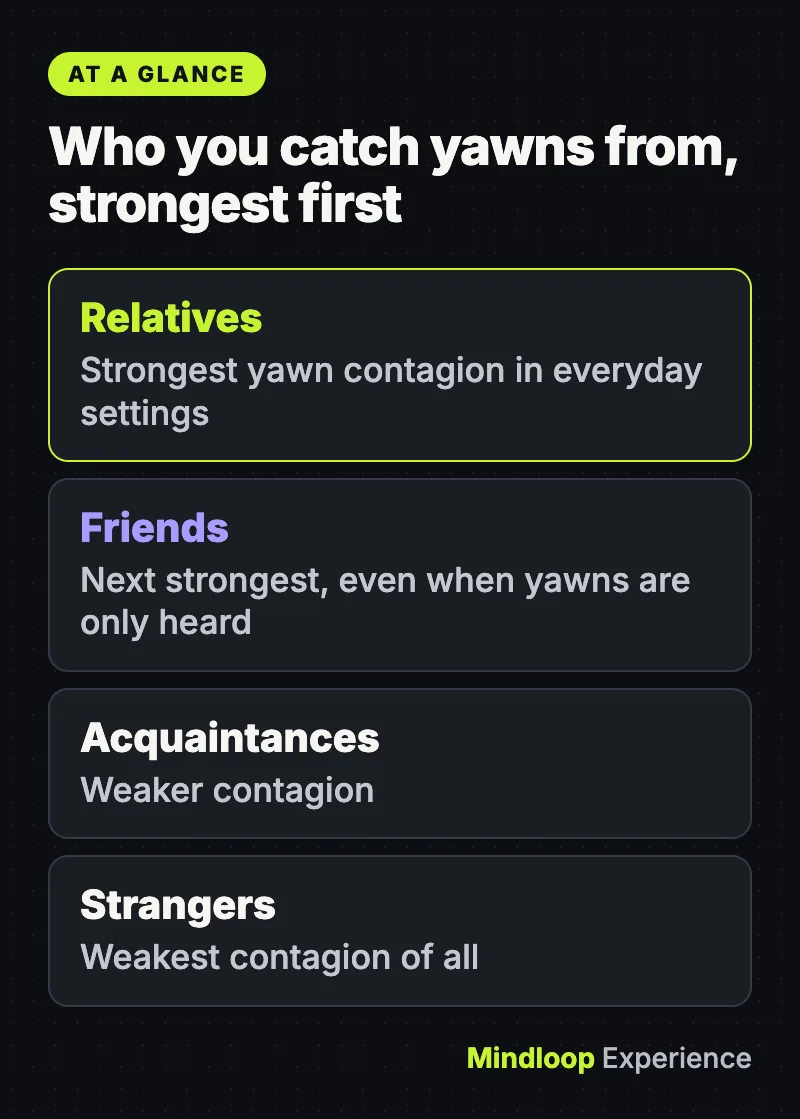
Italian researchers Norscia and Palagi spent a year observing adults yawning in everyday settings. Only social bonding predicted whether a yawn spread. Contagion was strongest in response to relatives, then friends, then acquaintances, and weakest with strangers. Nationality and sex did not explain it.
People may simply look at friends and family more, and so see more of their yawns. To test that, the same group later analyzed around 294 yawns that could be heard but not seen, drawn from more than 2,000 yawning bouts recorded over nine years. Even without visual contact, contagion was highest between friends and family members.
Why the empathy link is still disputed
Other studies have not found the same connection. Researchers at Duke University tested 328 people with a three-minute video of yawns and a battery of questionnaires. Each person’s tendency to catch yawns was very stable across sessions, but empathy, time of day and intelligence had no effect once age was taken into account. Older people were less likely to catch yawns, yet age explained only 8% of the variation. Most of the difference between people remained unexplained. Interestingly, most of the non-yawners were not resisting; they said they did not feel the urge at all.
In a 2017 review of the evidence, Massen and Gallup described the evidence for a link between contagious yawning and empathy as “inconsistent and inconclusive”. They pointed to confounding factors such as visual attention and social inhibition, which could explain some results without any empathy involved. The temperature studies add to the doubt, because they show contagion can rise and fall with factors that have nothing to do with personality.
The fair summary is that yawns spread more readily between people who are close, but whether that reflects empathy is still an open question. Something similar is true of other things your brain picks up without permission, such as songs that get stuck in your head.
Do animals yawn, and catch yawns?
Yawning is widespread among mammals and birds, as the duration studies show. Catching yawns is rarer, but it has been documented in several species.

- Chimpanzees: in a 2004 study, two of six adult females yawned significantly more after watching videos of other chimps yawning.
- Dogs: in a 2008 experiment, 21 of 29 dogs yawned after watching a person yawn, while fake mouth movements set off none of them. A later study found dogs responded to the sound of a human yawn, and more so when it came from someone familiar.
- Wolves: in a 2014 study, the strength of the social bond between wolves made contagious yawning more frequent.
- Budgerigars: these small parrots gave the first experimental evidence of contagious yawning outside mammals.
Did you know?
Contagious yawning is not only a mammal thing: budgerigars, small parrots, gave the first experimental evidence of contagious yawning outside mammals.
When yawning is worth mentioning to a doctor
For most people, yawning is harmless and simply a sign of tiredness. MedlinePlus, from the US National Library of Medicine, describes excessive yawning as yawning that happens more often than expected, even when you are drowsy. Possible causes it lists include:
- drowsiness or tiredness
- disorders that cause excessive daytime sleepiness
- a vasovagal reaction (stimulation of the vagus nerve), which can be caused by a heart attack or a tear in the aorta
- brain problems such as a tumor, stroke, epilepsy or multiple sclerosis
- certain medicines, rarely
- problems with the body’s temperature control, rarely
MedlinePlus advises contacting a health professional if you have unexplained, excessive yawning, or if your yawning comes with feeling very sleepy during the day. A doctor may ask when it started, how often it happens, whether it is linked to sleep, activity or medicines, and what other symptoms you have. A 2018 review of yawning in neurology also notes that it can be a sign of conditions including stroke, Parkinson’s disease and epilepsy, and that drug-induced yawning is uncommon.
Because heart attack is among the listed causes, sudden heavy yawning that comes with chest pain or feeling faint needs urgent medical help rather than a routine appointment. If it is a passing light-headed moment when you get up, our guide to why standing up fast makes you dizzy explains the usual, harmless cause.
Frequently asked questions
Possibly. In the 2007 study, breathing only through the nose stopped contagious yawning entirely, and a cold pack on the forehead cut it from 41% to 9%. It was a single lab study, so treat it as an interesting trick rather than a guarantee.
No. When researchers had people breathe pure oxygen or air with extra carbon dioxide, yawning did not change, and exercise that doubled breathing rate had no effect either.
In a study of 120 children aged one to six, contagious yawning became much more frequent at around age four.
Quite likely. In one study, 21 of 29 dogs yawned after watching a person yawn, and another found dogs yawned more at the sound of a familiar person yawning than an unfamiliar one.
Next time a yawn ripples around a meeting, blame a brain that may be trying to cool down and wake up at once.
Quick quiz
What did breathing pure oxygen do to yawning in the 1987 tests?
- Stopped it
- Made no significant difference
- Doubled it
Neither pure oxygen nor extra carbon dioxide made any significant difference to yawning.
In the 2007 study, which breathing method stopped contagious yawning?
- Breathing only through the nose
- Breathing through the mouth
- Breathing pure oxygen
When participants breathed only through their nose, none of them yawned in response to the videos.
At about what age does contagious yawning become much more frequent in children?
- One
- Six
- Four
In a study of 120 children aged one to six, contagious yawning became much more frequent at around age four.
Sources
Links last checked on 15 November 2026.
- Yawning as a Stereotyped Action Pattern and Releasing Stimulus. Ethology (1986)
- Yawning: no effect of 3-5% CO2, 100% O2, and exercise. Behav Neural Biol (1987)
- Yawning as a Brain Cooling Mechanism: Nasal Breathing and Forehead Cooling Diminish the Incidence of Contagious Yawning. Evolutionary Psychology (2007)
- Yawning and stretching predict brain temperature changes in rats: support for the thermoregulatory hypothesis. Front Evol Neurosci (2010)
- Contagious yawning and seasonal climate variation. Front Evol Neurosci (2011)
- A thermal window for yawning in humans: yawning as a brain cooling mechanism. Physiol Behav (2014)
- Yawn duration predicts brain weight and cortical neuron number in mammals. Biol Lett (2016)
- Brain size and neuron numbers drive differences in yawn duration across mammals and birds. Commun Biol (2021)
- The thermoregulatory theory of yawning: what we know from over 5 years of research. Front Neurosci (2012)
- Yawning – excessive: MedlinePlus Medical Encyclopedia
- Contagious yawning in autistic and typical development. Child Dev (2010)
- Yawn contagion and empathy in Homo sapiens. PLoS One (2011)


Write a response