
You spend roughly two hours of every night dreaming, according to the US National Institute of Neurological Disorders and Stroke (NINDS). Most mornings you remember almost none of it. The bits that do survive are often strange: a house with too many rooms, a test you forgot to revise for, a conversation with someone you have not seen in years.
Key takeaways
- You dream for about two hours a night, mostly in REM sleep, though dreams can happen in every stage.
- No single theory explains dreaming; memory, emotion, threat rehearsal and activation-synthesis ideas can overlap.
- Waking for about two minutes may be needed to store a dream, so some people recall far more.
- Frequent disruptive nightmares or regularly acting out dreams are worth raising with a doctor.
So what is all that dreaming for? The honest answer from NINDS is that its exact purpose is not known. But sleep science has learned a great deal about when dreams happen, what the brain is doing at the time, and which explanations hold up best. Here is what the research actually says, from sleep stages to lucid dreams, plus the two dream-related sleep problems worth taking to a doctor.
Sleep comes in stages
NINDS divides sleep into two basic types: rapid eye movement (REM) sleep and non-REM sleep, with three stages of non-REM.
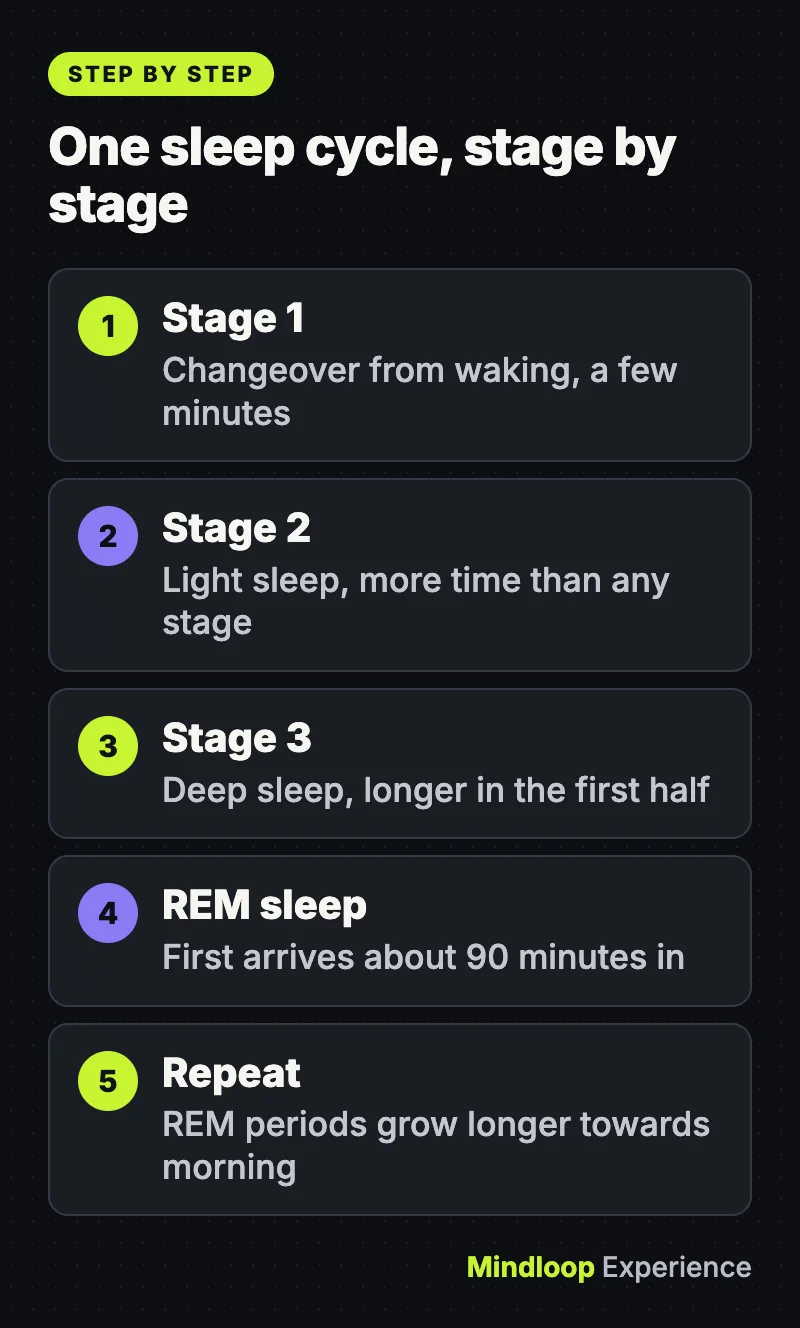
- Stage 1 is the short changeover from waking to sleep, usually lasting a few minutes.
- Stage 2 is light sleep. Heart rate and breathing slow, body temperature drops and eye movements stop. You spend more of the night here than in any other stage.
- Stage 3 is deep sleep, the kind you need to feel refreshed. It comes in longer stretches in the first half of the night, and it can be hard to wake someone from it.
- REM sleep first arrives about 90 minutes after you fall asleep. Your eyes dart from side to side behind closed lids, brain activity looks closer to waking, and breathing, heart rate and blood pressure rise toward daytime levels.
You cycle through these stages several times a night, and the REM periods grow longer toward morning.
In 1953, Aserinsky and Kleitman reported regularly occurring periods of eye movement during sleep in the journal Science. By 1957, Dement and Kleitman were publishing on the link between those eye movements and dreaming, which turned the dream into something scientists could study in the lab.
Why you do not act out your dreams
During REM, your arm and leg muscles are temporarily paralyzed. NINDS explains that the brainstem sends signals to relax the muscles that control posture and limb movement, “so that we don’t act out our dreams”. At the same time, the thalamus becomes active and sends the cortex “images, sounds, and other sensations that fill our dreams”.
When do dreams happen?
For decades, dreaming and REM sleep were treated as almost the same thing. NINDS still says most dreaming happens in REM and that dreams are usually most vivid there, but it also notes that you can dream in every stage.
A 2017 study in Nature Neuroscience made that clearer. Researchers woke people throughout the night and recorded detailed brain activity. Dreams were reported from both REM and non-REM sleep, and in both cases dreaming was linked to changes in a region toward the back of the brain that the authors called a “hot zone”. By monitoring that area in real time, they could predict whether someone woken from non-REM sleep would report a dream.
Earlier work by Solms, a researcher at the Royal London Hospital, pointed the same way. He argued that dreaming and REM sleep are controlled by different brain mechanisms. Damage to certain forebrain pathways can stop dreaming while leaving REM sleep untouched.
Did you know?
A 2017 Nature Neuroscience study found dreams in both REM and non-REM sleep. By watching a hot zone at the back of the brain, researchers could predict whether someone would report a dream.
The main theories of why we dream
No single theory has won, and the four below can overlap.
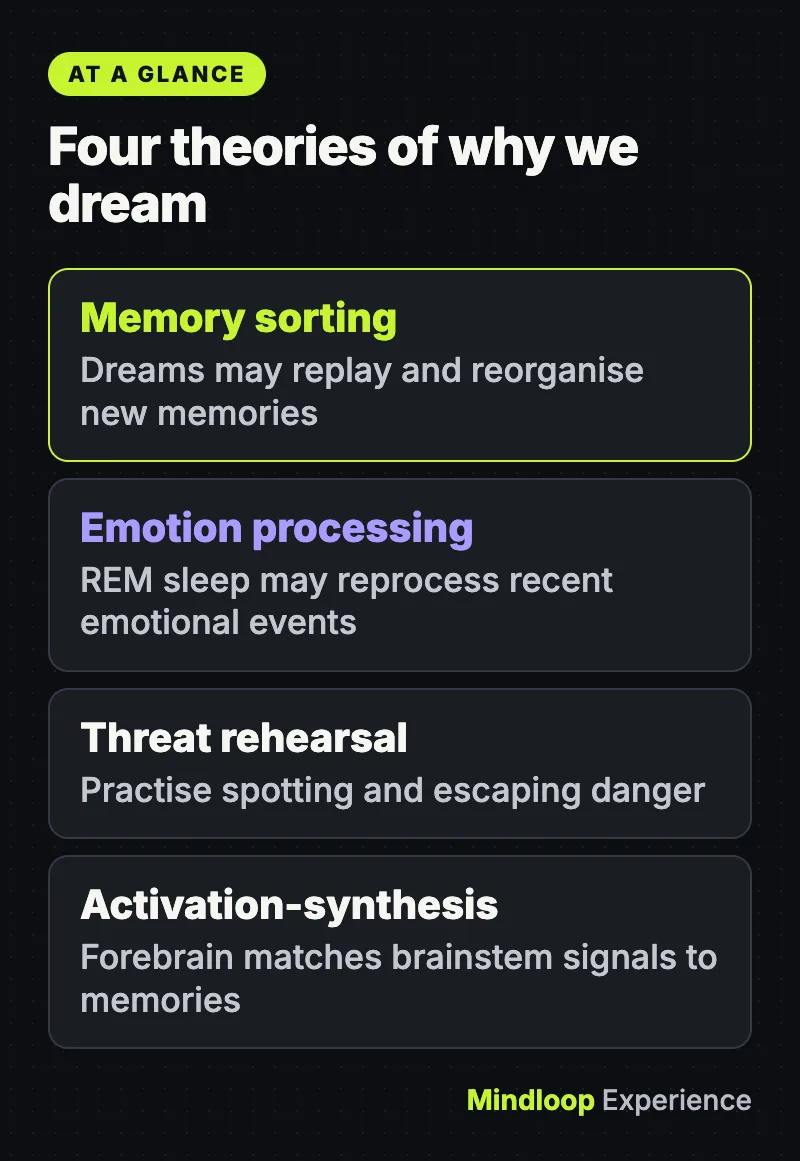
1. Sorting and strengthening memories
Sleep helps memory, and NINDS says memory consolidation most likely needs both non-REM and REM sleep. The question is whether dreams themselves play a part.
In a 2010 Harvard study, volunteers learned a virtual navigation task and were retested five hours later. Those who improved most were the ones who had dreamed about the task during an afternoon nap. Thinking about the task while awake did not predict improvement. The authors suggested that dreams may reflect the brain replaying and reorganizing new memories.
2. Processing emotions
NINDS says dreaming may help you process emotions, and notes that people under stress or with anxiety are more likely to have frightening dreams. A 2009 review by Walker and van der Helm at the University of California, Berkeley, titled “Overnight therapy?”, proposed that REM sleep reprocesses recent emotional experiences.
A follow-up study found that REM sleep was linked to an overnight drop in amygdala activity in response to earlier emotional experiences, and to people rating those experiences as less emotional the next day. Note that this measured REM sleep physiology rather than what people dreamed about, so it supports a role for REM more directly than for dream content.
3. Rehearsing for threats
Revonsuo, a researcher at the University of Turku in Finland, argued in 2000 that dreams are not random. His threat simulation theory proposes that dreaming evolved to simulate threatening events, so that our ancestors could practice spotting and escaping danger. He pointed to evidence from ordinary dream content, children’s dreams, recurring dreams, nightmares and the dreams of hunter-gatherers. The idea is hard to test directly and remains debated.
4. Activation-synthesis
In 1977, Hobson and McCarley proposed, in the American Journal of Psychiatry, the activation-synthesis hypothesis. In their view, the brainstem automatically switches the brain on during REM sleep and fires off bursts of signals. The forebrain then “synthesizes the dream” by matching those signals against stored memories. Solms’s later findings, that dreaming relies on forebrain systems and can happen without REM, are among the main challenges to the original version.
Why do we forget dreams so quickly?
Hobson and McCarley suggested that shifts in brain chemicals during sleep might account for “dream amnesia”. Newer research adds some detail.
- The brain may actively forget during REM. A 2019 study in Science found that a group of hypothalamus cells that are active in REM sleep contribute to forgetting certain memories in mice. The study did not look at dreams, but it suggests REM sleep can involve active forgetting.
- You may need to wake up for long enough. French researchers compared people who recall dreams often with those who rarely do. The high recallers remembered an average of 5.2 dreams a week against 0.5, and had more activity in two brain areas linked to attention and memory. A later study found high recallers also woke for longer stretches in the night, and the authors proposed that an awakening of about two minutes may be needed to store a dream in long-term memory.
That may help explain why some people recall far more dreams than others. Memory is slippery in other ways too, as anyone who has had a song stuck in their head for a day can confirm.
Did you know?
French researchers found people who recall dreams often remembered an average of 5.2 dreams a week, against 0.5 for rare recallers, and woke for longer in the night.
Nightmares and lucid dreams
Nightmares
In sleep medicine, a nightmare is a disturbing dream that wakes you up; a bad dream does not. The Sleep Foundation notes that nightmares are more common in REM sleep and in the second half of the night, and that about 2% to 8% of adults have problems with them. They are more common in children, especially between the ages of three and six.
Factors linked to more nightmares include stress and anxiety, post-traumatic stress disorder (PTSD), some medicines and withdrawal from them, and a lack of sleep, which can be followed by a “REM rebound” of vivid dreams. Alcohol close to bedtime can trigger a similar rebound later in the night.
Night terrors are different: they happen in non-REM sleep, usually early in the night, and are rarely remembered.
Lucid dreams
A lucid dream is one in which you know you are dreaming. A 2016 meta-analysis of 50 years of research estimated that 55% of people have had at least one lucid dream, and 23% have one at least once a month.
In 2021, four laboratories reported something remarkable. Working with 36 people in REM sleep, researchers put simple questions to lucid dreamers and got answers back through eye movements and facial muscle twitches. They recorded correct answers on 29 occasions from six of the participants.
By the numbers
55%have had a lucid dream
23%lucid dream at least monthly
2% to 8%adults with nightmare problems
When to see a doctor
Occasional nightmares and odd dreams are normal. Two patterns are worth getting checked.
Nightmare disorder
The American Academy of Sleep Medicine (AASM) estimates that nightmare disorder affects about 4% of adults. It means frequent nightmares that disrupt your sleep, mood or daytime life, not just the occasional bad night. It is treatable. In its 2018 position paper, the AASM recommends image rehearsal therapy, in which you rewrite a recurring nightmare into a new version and rehearse it while awake. Several other talk therapies and some medicines may also be used, so a doctor can help you choose.
REM sleep behavior disorder
In REM sleep behavior disorder (RBD), the normal muscle paralysis of REM sleep fails, and people physically act out their dreams. That can mean talking, shouting, punching or kicking, sometimes injuring themselves or a partner. The Sleep Foundation says it affects about 0.5% to 1% of adults, is more common in men and people over 50, and is often first noticed by a bed partner.
Diagnosis requires an overnight sleep study with video. Treatment can include medicines such as melatonin or clonazepam, along with making the bedroom safer.
RBD matters beyond the bruises because it can be an early sign of conditions such as Parkinson’s disease and dementia with Lewy bodies. A study of 1,280 people with sleep-study-confirmed RBD that had no known cause, followed at 24 specialist centers, found that 6.3% a year went on to develop a neurodegenerative condition, and an estimated 73.5% by 12 years. Those figures apply to that diagnosed group, not to anyone who sometimes twitches or talks in their sleep. If you or a partner notice regular dream enactment, though, mention it to a doctor.
If your sleep just feels off at certain times of year, our explainer on why the clocks change and what it does to sleep may also help.
Frequently asked questions
According to NINDS, yes. Everyone dreams, for about two hours a night, though you may not remember most of it.
Some do. NINDS notes that some people dream in color, while others only recall dreams in black and white.
After a period of too little sleep, the brain often catches up with extra REM sleep, a “REM rebound” that can bring vivid dreams and nightmares. Alcohol near bedtime can cause a similar effect in the second half of the night.
Fairly common. Roughly one in four people has a lucid dream at least monthly, and the AASM lists lucid dreaming therapy among options that may be used for nightmare disorder.
Dreams remain one of sleep science’s open questions, but the night shift your brain works is far busier than it feels.
Quick quiz
About when does REM sleep first arrive after you fall asleep?
- About 90 minutes in
- Straight away
- Only near morning
NINDS says REM sleep first arrives about 90 minutes after you fall asleep.
In which kind of sleep do night terrors happen?
- REM sleep
- Non-REM sleep
- Only during naps
Night terrors happen in non-REM sleep, usually early in the night, and are rarely remembered.
What does image rehearsal therapy ask you to do?
- Keep a dream diary
- Avoid REM sleep
- Rewrite a recurring nightmare and rehearse it awake
The AASM recommends rewriting a recurring nightmare into a new version and rehearsing it while awake.
Sources
Links last checked on 15 November 2026.
- Brain Basics: Understanding Sleep | National Institute of Neurological Disorders and Stroke
- Regularly occurring periods of eye motility, and concomitant phenomena, during sleep. Science (1953)
- The relation of eye movements during sleep to dream activity: an objective method for the study of dreaming. J Exp Psychol (1957)
- The neural correlates of dreaming. Nat Neurosci (2017)
- Dreaming and REM sleep are controlled by different brain mechanisms. Behav Brain Sci (2000)
- Dreaming of a learning task is associated with enhanced sleep-dependent memory consolidation. Curr Biol (2010)
- Overnight therapy? The role of sleep in emotional brain processing. Psychol Bull (2009)
- REM sleep depotentiates amygdala activity to previous emotional experiences. Curr Biol (2011)
- The reinterpretation of dreams: an evolutionary hypothesis of the function of dreaming. Behav Brain Sci (2000)
- The brain as a dream state generator: an activation-synthesis hypothesis of the dream process. Am J Psychiatry (1977)
- REM sleep-active MCH neurons are involved in forgetting hippocampus-dependent memories. Science (2019)
- Resting brain activity varies with dream recall frequency between subjects. Neuropsychopharmacology (2014)



Write a response