The UAE and Saudi Arabia both want to be among the world’s AI leaders, and both have official plans with dates on them: 2031 for the UAE, 2030 (and now 2034) for Saudi Arabia. Most coverage treats them as a race and quotes GDP percentages that aren’t targets in either plan. This explainer sticks to what the official pages actually say: the goals, the priority sectors, who is in charge, which numbers are real targets, and what it all means if you live, work or run a business in either country. Every figure below was checked on November 17, 2026 on official pages, or comes from named press where noted.
Key takeaways
- The UAE strategy, first launched in 2017, aims to make the country one of the world’s AI leaders by 2031.
- Saudi Arabia’s SDAIA strategy targets the top 15 countries in AI, 20,000+ specialists and SAR 75 billion by 2030.
- SDAIA’s 2026 refresh adds 2034 targets, including up to 55,000 data and AI specialists and 40,000 open datasets.
- Both countries have a PDPL; Saudi Arabia’s gives companies 30 days to act on your data request.
What the UAE AI Strategy 2031 says
The UAE first launched its national AI strategy in 2017, according to a WAM report from October 2019. The full text lives on the AI Office’s strategy page, and its headline goal is short: “to become one of the world leaders in A.I. by 2031.” The page ties the plan to the UAE Centennial 2071 and says the country will focus on domains where it can lead, not on every technology.
The strategy sets out eight objectives:
- Build a reputation as an AI destination.
- Increase the UAE’s competitive assets in priority sectors through deployment of AI.
- Develop a fertile ecosystem for AI.
- Adopt AI across customer services to improve lives and government.
- Attract and train talent for future jobs enabled by AI.
- Bring world-leading research capability to work with target industries.
- Provide the data and supporting infrastructure essential to become a test bed for AI.
- Ensure strong governance and effective regulation.
It names five priority sectors. Three build on existing strengths: resources and energy, logistics and transport, and tourism and hospitality. Two are “emerging” sectors: healthcare and cybersecurity. Within these five, the government says it will “fund or broker pilot projects.” The Dubai government’s AI Sandbox, which lets companies test AI products with regulators, is the kind of test bed objective 7 describes.
One number often quoted as a target is really an estimate. The strategy says AI “has the potential to generate up to AED 335 billion in the UAE economy,” and breaks out AED 136 billion in services and trade, AED 91 billion in resources and utilities and AED 19 billion in logistics. These are the authors’ modeled gains, used to pick sectors. The strategy text on ai.gov.ae sets no GDP percentage target. Projections do exist: the 2019 WAM report cites the UAE AI website’s estimate that AI could boost GDP by 35 percent ($96 billion), but that is a forecast, not a goal in the plan.
The clearest numeric goal today sits on the AI Office’s home page: the 1 Million AI Talents initiative, which aims to train 1 million people in AI by 2027.
Did you know?
The AED 335 billion often quoted for the UAE strategy is an estimate of what AI could add to the economy, used to pick priority sectors, not a target.
Who runs AI in the UAE
- The Minister of State for Artificial Intelligence, Digital Economy and Remote Work Applications. The post is held by Omar Sultan Al Olama, whose office runs ai.gov.ae and owns the strategy.
- The UAE Artificial Intelligence and Blockchain Council. According to the strategy, it includes representatives from all emirates, at federal and local level, and its job is to identify how and where AI can be used in government.
- Abu Dhabi’s Artificial Intelligence and Advanced Technology Council (AIATC). The Abu Dhabi Media Office says the UAE President set it up on January 22, 2024, and on March 11, 2024 it announced MGX, a technology investment company with Mubadala and G42 as “foundational partners.” MGX invests in three areas: AI infrastructure such as data centers, semiconductors, and AI core technologies and applications. Sheikh Tahnoon bin Zayed, the council’s chair, called it “a UAE national champion,” a phrase that has since reached Washington too, as our explainer on AI national champions shows.
- G42. The same release describes G42 as working in cloud computing, advanced data centers and specialized AI applications. Its own site lists the UAE–US 5GW AI Campus and Stargate UAE among the initiatives its international arm leads.
- TII and Falcon. Abu Dhabi’s Technology Innovation Institute builds the Falcon models, including Falcon Arabic, built for Modern Standard Arabic and dialects, and the 7-billion-parameter Falcon-Emirati.
For residents, the most visible piece is government services. On May 30, 2023, WAM reported that U-Ask, a generative AI chatbot for government services in Arabic and English, was live on the official portal u.ae.
Did you know?
The UAE’s U-Ask chatbot for government services went live on the official portal u.ae on May 30, 2023, answering in both Arabic and English.
What Saudi Vision 2030 and SDAIA’s strategy say
Vision 2030, launched in 2016, is Saudi Arabia’s overall reform plan. It has three themes (a vibrant society, a thriving economy and an ambitious nation), and its strategic objectives include “Develop the digital economy” and “Develop the e-government.” The Vision 2030 pages we read set no AI-specific number. The AI targets come from a separate plan that serves the Vision.
That plan is the National Strategy for Data & AI (NSDAI). SDAIA says King Salman approved it on July 17, 2020, and it was launched that year at the first Global AI Summit. It runs in three stages: “National Enabler” (2021), “Specialist” (2025) and “Industry Leader” (2030). Its six targets are specific:
| Area | Target on SDAIA’s strategy page |
|---|---|
| Ambition | Rank among the top 15 countries in AI |
| Skills | 20,000+ data and AI specialists and experts |
| Policies and regulations | Rank among the top 10 countries in open data |
| Investment | Attract about SAR 75 billion in data and AI investments |
| Research and innovation | Rank among the top 20 countries in scientific contribution |
| Ecosystem | Create 300+ data and AI startups |
The five priority sectors are education, government, healthcare, energy and mobility. Compare that with the UAE’s list: both pick energy and healthcare, but Saudi Arabia adds education and government as sectors in their own right, while the UAE adds tourism, logistics and cybersecurity.

SDAIA’s 2026 refresh: new targets to 2034
The SDAIA strategy page now also links a three-page Strategy Refresh. It says “work is underway to update NSDAI” and lists “2026: Update of NSDAI” as a milestone. The new vision is for Saudi Arabia “to rank among the world’s top 10 smart nations,” built on five pillars with 17 objectives: sovereign and secure infrastructure, national data management, digital platforms and services, AI applications and products, and sector enablement.
Its first published targets (the document calls them “non-exhaustive”) all run to 2034:
- Up to 55,000 data and AI specialists trained.
- Approximately 40,000 open government datasets made available.
- 100% of government services reachable through the national super app.
- Approximately 80% on the National AI Index for government AI readiness.
The jump from 20,000 specialists by 2030 to up to 55,000 by 2034 is the clearest sign the plan has grown. Saudi Arabia also made AI the theme of the year: Arab News reported on March 11, 2026, citing the Saudi Press Agency, that the Cabinet had designated 2026 the Year of Artificial Intelligence.
By the numbers
55,000AI specialists by 2034
40,000open datasets by 2034
100%services on the super app
Who runs AI in Saudi Arabia
- SDAIA, the Saudi Data & AI Authority. According to its About page, it was set up by Royal Order No. A/471 dated 29/12/1440 AH (2019), reports directly to the Prime Minister, and is “the national reference in all matters related to” data and AI. The Crown Prince chairs its board. It has three sub-entities: the National Data Management Office (NDMO), the National Center for AI (NCAI) and the National Information Center (NIC).
- HUMAIN. On May 12, 2025, PIF announced HUMAIN, a PIF-owned company chaired by the Crown Prince that will “operate and invest across the AI value chain”: data centers, AI infrastructure and cloud, and AI models, including “one of the world’s most powerful multimodal Arabic large language models.” SDAIA’s refresh lists HUMAIN’s launch as a 2025 milestone.
- ALLaM. ALLaM is a family of Arabic language models “developed by the National Center for Artificial Intelligence (NCAI) at the Saudi Data and AI Authority (SDAIA),” according to its Hugging Face model card, now published under HUMAIN’s account.
In short, the UAE spreads AI across a federal minister, councils and Abu Dhabi investment vehicles, while Saudi Arabia runs strategy, data and regulation through one authority and puts the commercial build-out in one PIF company. If you follow the hardware side, both countries’ data center plans depend on access to advanced chips, which is where export controls on AI chips come in.

UAE vs Saudi Arabia, side by side
As of November 17, 2026, from the official pages above:
| UAE | Saudi Arabia | |
|---|---|---|
| Main AI plan | National Strategy for AI 2031 (first launched 2017) | National Strategy for Data & AI (approved July 17, 2020), serving Vision 2030 |
| Headline goal | One of the world leaders in AI by 2031 | Top 15 countries in AI by 2030; refresh aims for top 10 smart nations |
| Numeric targets | 1 million people trained in AI by 2027 | 20,000+ specialists, SAR 75 billion investment, 300+ startups by 2030; up to 55,000 specialists by 2034 |
| Priority sectors | Resources and energy, logistics and transport, tourism and hospitality, healthcare, cybersecurity | Education, government, healthcare, energy, mobility |
| Who is in charge | Minister of State for AI and the AI Office; UAE AI and Blockchain Council; Abu Dhabi’s AIATC | SDAIA (with NDMO, NCAI, NIC), reporting to the Prime Minister |
| Big companies | MGX (Mubadala and G42 as foundational partners), G42 | HUMAIN (PIF-owned) |
| Arabic models | Falcon (TII), incl. Falcon Arabic and Falcon-Emirati | ALLaM (built at SDAIA’s NCAI, published by HUMAIN) |
| Data protection law | Federal Decree-Law No. 45 of 2021, in force January 2, 2022 | PDPL, Royal Decree M/19, amended by M/148 |
Data rules: the two PDPLs in plain English
Both countries have a Personal Data Protection Law, usually shortened to PDPL. They’re separate laws with different details.
UAE. The official portal says Federal Decree-Law No. 45 of 2021 came into force on January 2, 2022. It covers processing of personal data, fully or partly by electronic systems, “inside or outside the country.” It bans processing without the owner’s consent except in set cases, gives you the right to correct inaccurate data and to restrict or stop its processing, and sets rules for sending data abroad. The portal also notes that the DIFC has its own data protection law (DIFC Law No. 5 of 2020). It doesn’t list fine amounts.
Saudi Arabia. SDAIA publishes the law and its implementing regulation, issued by Royal Decree No. M/19 and amended by Royal Decree No. M/148. In plain English:
- You can ask a company what data it holds on you, get a copy in a readable format, correct it, or ask for it to be destroyed when it is no longer needed.
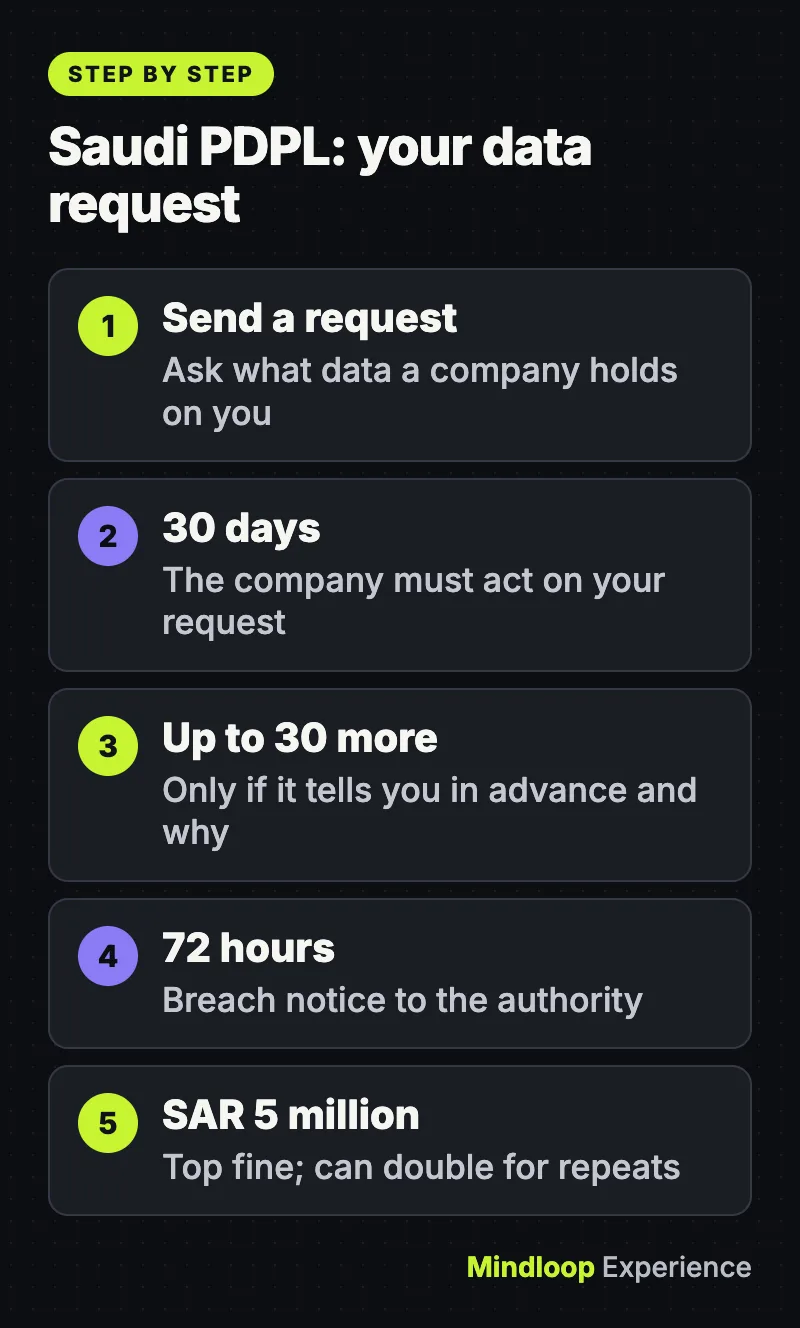
- The company must act on your request within 30 days. It can extend that by another 30 days, but only if it tells you in advance and gives the reason.
- If a breach could harm you or your data, the company must notify the authority within 72 hours of becoming aware of it.
- Breaking the law can bring a warning or a fine of up to SAR 5 million, which can be doubled for repeat violations. Disclosing sensitive data to harm someone can mean up to two years in prison or a fine of up to SAR 3 million.
SDAIA’s laws page also carries AI rules that apply beyond data: its AI ethics principles, a deepfakes guideline, and two generative AI guidelines, one for government employees and one for the public.
What it means for you
If you live in either country, AI is arriving mostly through government services and apps, in Arabic and English. Features also tend to land in stages, as with Amazon’s Alexa for Shopping beta in the UAE.
If you work in tech, both plans are talent plans. The UAE wants 1 million people trained in AI by 2027; Saudi Arabia wants up to 55,000 data and AI specialists by 2034. Expect more state-backed courses, and expect employers to ask for AI skills.
If you run a business, data law comes first. Map which customer data you hold, write a privacy policy, and have a breach plan that can meet Saudi Arabia’s 72-hour notice. Check whether a free zone such as the DIFC has its own rules.
To follow the plans or try the national tools yourself:
- Read the plans in the original. The UAE strategy is at ai.gov.ae/strategy, and SDAIA’s targets and 2026 refresh are on its strategy page. Both sites have Arabic versions.
- Ask U-Ask on u.ae for government service questions in Arabic or English.
- Try Falcon Chat. On November 17, 2026, chat.falconllm.tii.ae described itself as a “free, multi-model AI assistant” and offered a “Continue as Guest” button next to sign-in.
- Look at HUMAIN Chat. Arab News reported on August 26, 2025 that the app runs on ALLaM 34B and is available on iOS, Android and the web, with other Arabic-speaking countries to follow. On November 17, 2026, chat.humain.com opened to a sign-in page (Apple, Google or email). We didn’t test whether accounts work outside Saudi Arabia.
- Run ALLaM yourself. ALLaM-7B-Instruct-preview is on Hugging Face under the Apache 2.0 license, with code for the Transformers library and vLLM.
- Use your data rights. In Saudi Arabia, send a written request to the company and note the date: the 30-day clock starts then.
For more on how the region is building with AI, browse our Gulf & Middle East tech hub, or see the rest of our Tech Business coverage. Both plans are living documents: when SDAIA publishes the full updated NSDAI, we’ll update this comparison.
Frequently asked questions
What is the UAE AI Strategy 2031?
It is the UAE’s national AI plan, first launched in 2017. It aims to make the UAE one of the world leaders in AI by 2031 through eight objectives and five priority sectors: resources and energy, logistics and transport, tourism and hospitality, healthcare and cybersecurity.
What does SDAIA do in Saudi Arabia?
SDAIA, the Saudi Data & AI Authority, is the national reference for data and AI. It reports directly to the Prime Minister, sets the National Strategy for Data & AI, and runs the NDMO, the National Center for AI and the National Information Center.
Can I use ALLaM outside Saudi Arabia?
ALLaM-7B-Instruct-preview is published on Hugging Face under the Apache 2.0 license, so you can download and run it. Whether HUMAIN Chat accounts work outside Saudi Arabia wasn’t tested; Arab News reported other Arabic-speaking countries would follow.
Does the UAE have a personal data protection law?
Yes. Federal Decree-Law No. 45 of 2021 came into force on January 2, 2022. It requires consent for processing except in set cases, lets you correct data or restrict its processing, and sets rules for sending data abroad. The DIFC has its own law.
Quick quiz
What is Saudi Arabia’s headline AI ranking target for 2030 on SDAIA’s strategy page?
- Top 5
- Top 25
- Top 15
SDAIA’s page says the ambition is to rank among the top 15 countries in AI.
Which company did PIF launch on May 12, 2025 to work across the AI value chain?
- HUMAIN
- MGX
- G42
PIF announced HUMAIN, a PIF-owned company chaired by the Crown Prince.
Within how many hours must a company notify the authority of a harmful breach under Saudi rules?
- 24
- 72
- 120
The implementing regulation sets a 72-hour notice for breaches that could cause harm.
Sources
- UAE National Strategy for Artificial Intelligence 2031 (UAE Artificial Intelligence Office)
- National Strategy for Data & AI (SDAIA)
- Saudi Data & AI Authority: Strategy Refresh (SDAIA, PDF)
- HRH Crown Prince launches HUMAIN as global AI powerhouse (PIF, May 12, 2025)
- Abu Dhabi Launches Comprehensive Global Investment Strategy on Artificial Intelligence (Abu Dhabi Media Office, March 11, 2024)
- Data protection laws (The Official Portal of the UAE Government)
- Saudi Data & AI Authority’s Laws and Regulations (SDAIA)
- Saudi Arabia designates 2026 the Year of Artificial Intelligence (Arab News, March 11, 2026)



Write a response