Updated November 14, 2026. This is a developing story. The FAA has not yet published an official root cause, and the cancellation figures below are snapshots from flight trackers, so they will keep moving.
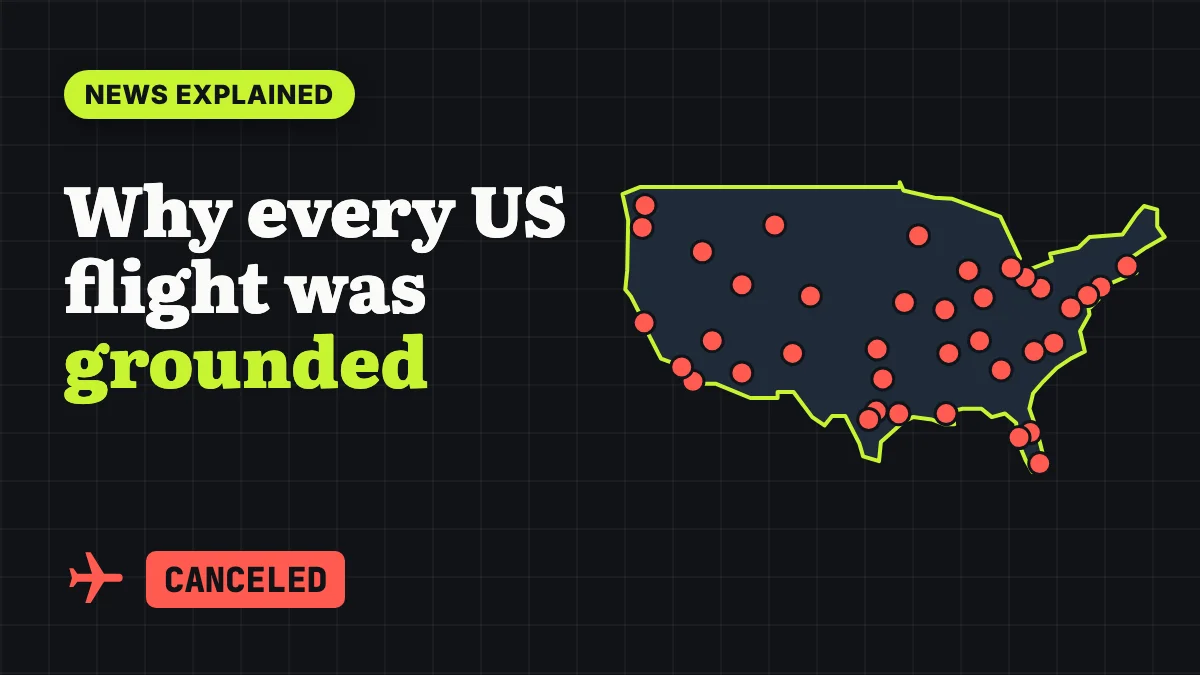
On Friday afternoon, November 13, 2026, the Federal Aviation Administration did something it almost never does: it stopped departures at every airport in the United States at once. For a little over four hours, no airliner could take off anywhere in the country, while the more than 3,500 flights already in the air landed safely, according to Transportation Secretary Sean Duffy.
By the time the airspace reopened that evening, thousands of flights had been canceled, airports were packed with stranded travelers, and Reuters was calling it the longest nationwide shutdown since the September 11, 2001 attacks.
Here is what happened, what a ground stop actually is, what officials say broke, and what you can do if your trip was caught up in it.
What happened: the timeline (all times ET)
The FAA’s own statement is short. It says the agency “issued a nationwide ground stop for all U.S. airports following communication issues impacting multiple Air Route Traffic Control Centers,” and that “FAA technicians are investigating the issue.” The statement is marked as preliminary and subject to change (FAA).
Pieced together from the officials’ briefings and news reports, Friday went roughly like this:
- 3:36 p.m.: Trouble began, according to Transportation Secretary Sean Duffy, when air traffic control centers experienced “instability in radar and communications systems” (Reuters).
- Shortly before 4 p.m.: The FAA ordered the nationwide ground stop. More than 3,500 flights were airborne at that moment, and Duffy said all of them landed safely (Scripps News).
- 8:15 p.m.: “At 8:15 tonight, Eastern time, we’ve opened up the airspace,” Duffy said (CBS News). CNBC put the total length at “more than four hours” (CNBC).
Reopening the airspace did not mean everyone flew home that night. “Now does that mean every flight is going to fly right now? It’s going to be slow,” Duffy said. “So if you’re watching, you’re at an airport, check with your airline” (CBS News).
What a ground stop is
A ground stop is one of the FAA’s bluntest traffic-management tools. It tells airlines that flights may not take off, either for a single destination airport or, in rare cases like this one, anywhere in the country. Planes already in the air are not affected by the order itself: they keep flying and land as normal.
Most ground stops are small and local: a thunderstorm or fog at one airport, usually for an hour or two. A nationwide stop is used only when the system as a whole can’t be trusted to handle new traffic safely.
The logic is simple. Air traffic controllers depend on two things above all: radar, which shows them where every aircraft is, and radio, which lets them talk to pilots. If either becomes unreliable, the safest move is to stop adding planes to the sky until it is fixed. That is why the stop applied to departures, not to the flights already en route.
Homeland Security Secretary Markwayne Mullin stressed that point on Friday: “The public was never in danger through this process,” he said, describing the grounding as a precaution (Scripps News).
What broke, and why old gear matters
The behind-the-scenes picture is still forming, but officials gave a consistent first explanation: aging network hardware could not keep up.
“Our switches, our routers actually got overloaded with data and they started to give us inconsistencies in the data from those routers and because of that we shut the system down,” Duffy said (Reuters). Aviation Week reported that the FAA pointed to “overloaded analog switches and routers,” with the instability affecting radar and communications at centers and approach-control facilities across the country (Aviation Week).
Why “analog” is a problem in 2026
Switches and routers are the plumbing of any network. They pass data from one place to another: radar feeds, radio links, flight plans and the hand-offs between control centers as a plane crosses the country. Much of the equipment in the US air traffic system was designed decades ago, for far less traffic and far less data than it carries today.
Old gear tends to fail in two ways. It has less spare capacity, so a surge in data can push it past its limits. And when it struggles, it can produce what Duffy described as “inconsistencies”: data that is wrong or out of step rather than simply missing. For controllers, a radar picture that might be wrong is arguably worse than one that is blank, because you can’t safely separate aircraft on information you don’t trust. “What we have is an incredibly old air traffic control system,” Duffy said (Reuters).
Was it a cyberattack?
Officials said they have seen no evidence of one. “There is nothing that indicates the incident was caused by a cyberattack,” Mullin said. “It appears this was mechanically driven” (Scripps News). Reuters reported that he called the evidence of a cyberattack “zero” so far, while noting that investigators had not formally ruled anything out (Reuters).
What is still unconfirmed
Some details conflict, and none has been confirmed by the FAA yet. CBS News reported, citing multiple sources, that an update to the private communications network connecting the air traffic control system caused it to reboot and crash. CBS said the network is operated by L3Harris, which had not responded to a request for comment, and Mullin said new security patches added to the older system appeared to have played a role (CBS News). Treat those as early reports until the FAA publishes its review.
How big the disruption was
Every flight tracker counts a little differently, so the numbers depend on who you ask and when:
- Flightradar24: more than 6,600 flights canceled and 8,600 delayed, with another 1,500 already canceled for Sunday, as reported by Reuters (Reuters).
- FlightAware: more than 7,700 flights within, into or out of the US canceled on Friday and more than 8,000 delayed, plus more than 2,000 cancellations for Saturday, as reported by CNN early on November 14 (CNN). FlightAware’s live cancellations page is the place to watch the weekend numbers change.
- Cirium: 11,000 flights had been scheduled to leave US airports after 4 p.m. ET on Friday, carrying about 1.5 million passengers (CNBC).
The knock-on effects are the reason the weekend is messy. When planes and crews end the day in the wrong cities, and crews run into their legal limits on duty hours, airlines can’t simply restart Friday’s schedule. They have to rebuild it, which is why cancellations keep appearing a day or two later.
How it compares to past ground stops
The January 2023 NOTAM outage. On January 11, 2023, the FAA paused all domestic departures after the system that publishes Notices to Air Missions, the safety bulletins pilots must check before flying, went down overnight. The FAA ordered the pause at 7:15 a.m. EST and lifted it by 8:50 a.m. The agency later traced the outage to a damaged database file and said contract personnel had “unintentionally deleted files,” with no evidence of a cyberattack (FAA). Reuters described that event as the only other nationwide ground stop since 9/11. Friday’s stop lasted roughly three times as long.
September 11, 2001. The 9/11 attacks led to a far more drastic step: US airspace was closed entirely, planes already flying were ordered to land at the nearest available airport, and civilian flights stayed grounded for days (background). Friday’s event was a precaution over equipment, not a security emergency, but it is the longest nationwide shutdown since then, according to Reuters.
What happens next for modernization
The outage landed in the middle of a long-running fight over money for air traffic control. In 2025, Duffy announced a plan to build a “brand new” air traffic control system, and Congress approved $12.5 billion toward it in the budget law signed that July (Flying).
Administration officials say that is not enough. Earlier on Friday, before the outage, the White House and the Department of Transportation had urged Congress to approve $30.1 billion more, and after the outage Duffy called for $50 billion to modernize the system, according to Reuters (Reuters). “This is an emergency. I want Congress to give us emergency funding,” he said (Scripps News). He also warned: “You will have more of these” without an upgrade (CBS News).
Expect three things over the coming weeks: an official FAA account of the root cause, congressional hearings, and a fresh push on funding. Duffy said he did not expect the disruption to affect Thanksgiving travel (CNN).
What travelers can do now
If your flight was canceled or badly delayed, here is where you stand under US Department of Transportation rules. Always check the official page before you argue with an airline: transportation.gov refunds.
- Start with your airline’s app or website. Rebooking is usually fastest there, and agents at the airport are swamped. Duffy’s advice on Friday was the same: check with your airline.
- You are owed a refund if the airline canceled. DOT says a consumer “is entitled to a refund if the airline cancelled a flight, regardless of the reason, and the consumer chooses not to travel or accept travel credits, vouchers, or other forms of compensation.” That includes a cancellation caused by an FAA outage.
- A big delay or change counts too. If your flight is changed or delayed by 3 hours or more on a domestic trip (6 hours or more internationally) and you turn down the new option, you are also due a refund.
- You don’t have to accept a voucher. If you decline the airline’s offer, DOT says the refund must be issued automatically, within 7 business days for credit card purchases and 20 calendar days for other payment methods.
- Don’t count on meals or hotels. Airlines’ public commitments to cover meals and hotels apply to “controllable” cancellations and delays, which DOT describes as ones “caused by the airline,” such as maintenance or crew problems (DOT dashboard). Reuters reported that airlines will not be required to compensate stranded passengers for this outage, because the carriers were not responsible for it. Some airlines may still offer help, so ask.
- Booked through a travel site? DOT says to contact the travel agent first for the refund.
More on large outages and what to do during one: why Outlook and Teams went down in the Microsoft 365 outage, what the Workday outage meant for clocking in and pay, and how to check a service’s status page and keep working during an outage.
Frequently asked questions
The FAA reopened the airspace at 8:15 p.m. ET on Friday after checking that its systems were stable. Officials said the public was never in danger, because the ground stop stopped new departures rather than leaving planes in the air without support.
Airlines had planes, pilots and flight attendants scattered in the wrong places, and crews have legal limits on how long they can work. Rebuilding the schedule takes time, so cancellations can continue into the weekend.
Officials said there is no evidence of a cyberattack, and the Homeland Security secretary said it appears to have been “mechanically driven.” The investigation is ongoing.
Officials themselves say yes, unless the old equipment is replaced. Duffy warned that “you will have more of these” without new funding, and the FAA has not yet explained exactly what failed.
Sources
Links last checked on 15 November 2026.




Write a response