
Quick quiz: what do CoreWeave, Crusoe, Mistral AI, Lambda, Black Forest Labs and Reflection AI have in common? According to TechCrunch, Nvidia has backed every one of them. PitchBook says Nvidia joined 105 startup funding rounds this year alone, often as the largest investor.
Key takeaways
- Nvidia joined 105 startup funding rounds in 2026, often as the largest investor, according to PitchBook via TechCrunch.
- Jensen Huang resigned as CEO on 12 November, and investors credit him with most of those investment decisions.
- Investors expect interim CEO Colette Kress to be more selective and write smaller checks, though that is not announced policy.
- Nvidia’s filing still lists $25 billion in committed equity investments, and open-model backers are watching Nemotron and Hugging Face.
Now the person investors credit with that spending spree, per TechCrunch, has resigned. Those investors are asking who writes the checks next.
The check-writer, in numbers
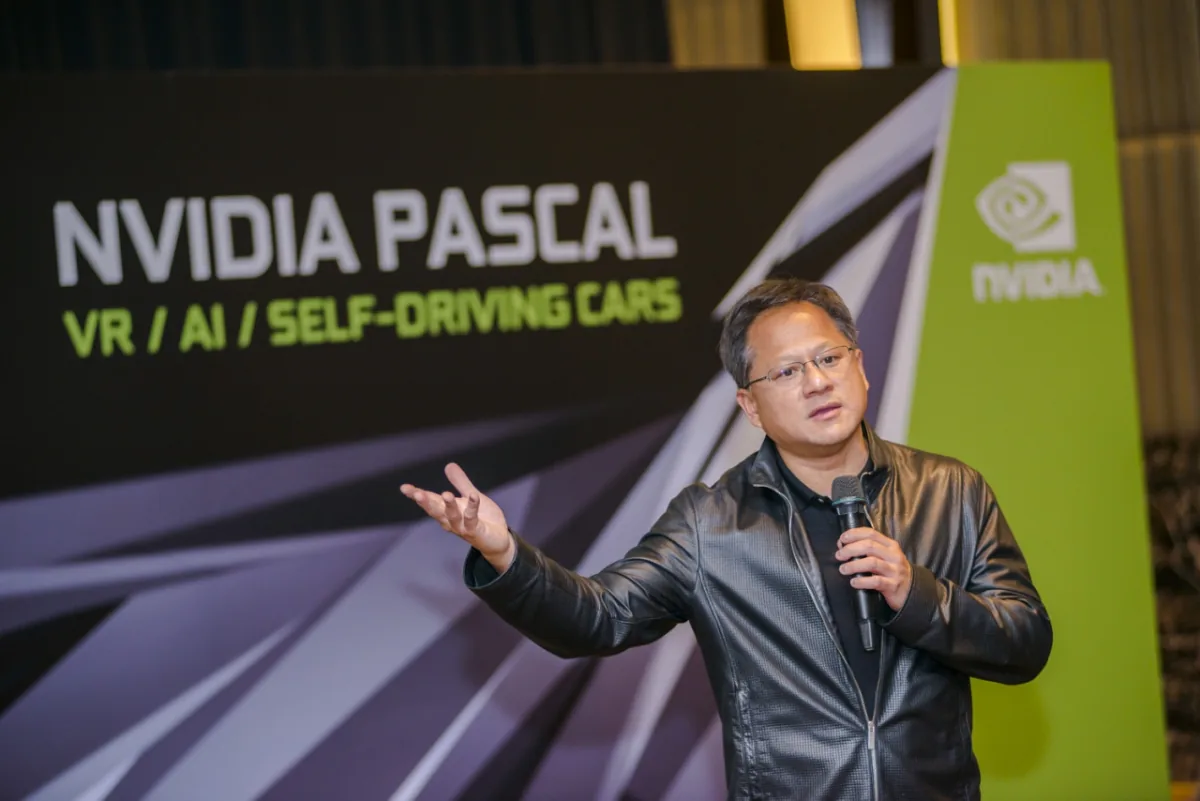
Nvidia announced on 12 November that Jensen Huang had resigned as president, CEO and board member. CFO Colette Kress is interim CEO. The announcement gave no reason, and our explainer on the resignation covers the facts.
Here is how big Nvidia’s investing arm had grown:
| Figure | What it is | Source |
|---|---|---|
| 105 | Startup rounds joined in 2026 so far | PitchBook, via TechCrunch |
| 67 | Venture deals in 2025 | TechCrunch roundup |
| $40 billion+ | Equity deals committed in early 2026, including $30 billion for OpenAI | CNBC, via TechCrunch (9 May) |
| $47.9 billion | Non-marketable equity securities, mostly private companies, at 26 July 2026 | Nvidia’s quarterly filing |
| $25 billion | Further equity investments committed, subject to “certain contingencies” | Nvidia’s quarterly filing |
The filing says Nvidia committed to equity investments in “AI model makers, infrastructure financiers, and other private companies.” Of the $25 billion, $18 billion falls in the rest of fiscal 2027, which ends in January 2027. Nothing in the filing says whether those plans will change.
TechCrunch’s examples give a feel for the range. Nvidia backed CoreWeave while it was still private and took part in two Crusoe rounds, including its $1.4 billion Series E. TechCrunch says Nvidia was often the largest investor in those deals.
A quick glossary. Neoclouds are cloud companies built around renting GPUs. Inference providers run finished AI models for paying customers. TechCrunch says Nvidia’s biggest bets were on neoclouds, inference providers and open-weight models, all of which are expensive for smaller companies to build.
By the numbers
105startup rounds joined in 2026
$47.9 billionnon-marketable equity securities
$25 billionfurther equity commitments
Why the checks mattered more than their size
TechCrunch’s reporting on 13 November leans on investors and founders, so read what follows as their views, not established fact.
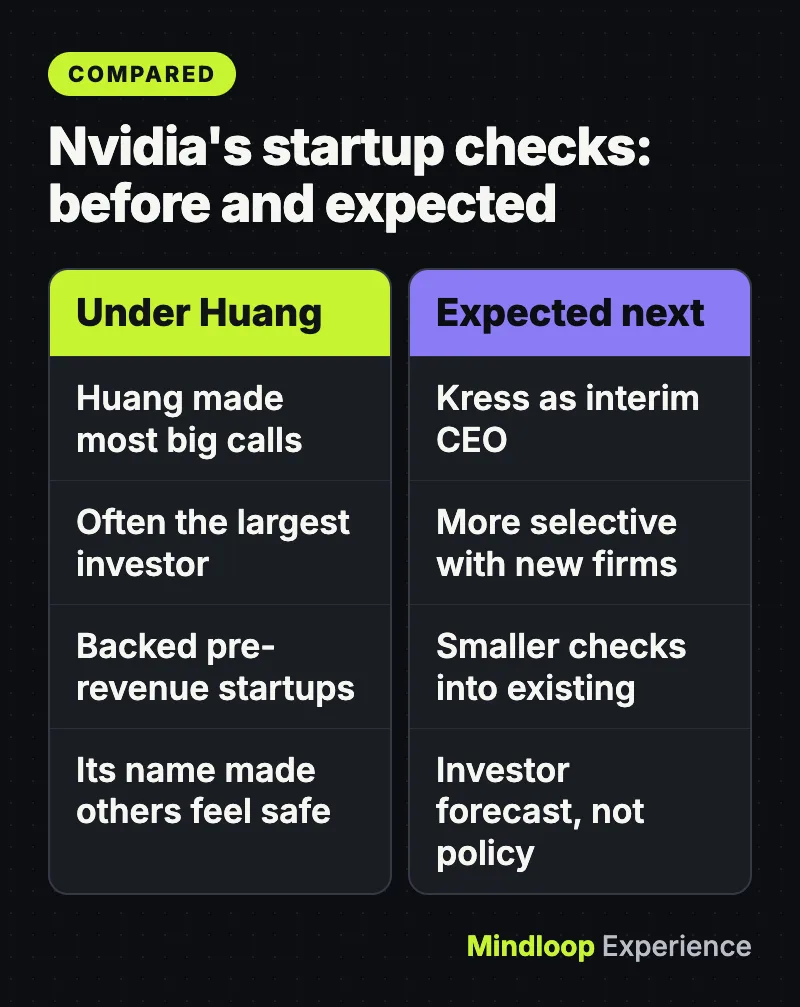
Umesh Padval of Seligman Ventures said most of the significant decisions to invest in startups came from Huang himself. He added: “When Nvidia was on the cap table, everyone felt safe.” The cap table is the list of who owns a startup.
One VC told TechCrunch that infrastructure companies needing $100 million to $500 million of GPUs would often raise half of that from Nvidia at valuations of $1 billion or more. Nvidia’s participation gave other investors comfort to back those companies at lofty valuations, per TechCrunch.
Surprising fact: Nvidia wrote an $800 million check into a $2 billion Series B for Reflection AI last year, before the open-source startup had meaningful revenue, according to the Wall Street Journal as cited by TechCrunch. Early bets like that are what investors told TechCrunch they expect to shrink.
Did you know?
Nvidia wrote an $800 million check into a $2 billion Series B for Reflection AI before the open-source startup had meaningful revenue, according to the Wall Street Journal as cited by TechCrunch.
What founders and investors fear
TechCrunch quotes several people:
- A neocloud founder, on hearing the news: “It’s like a bomb went off.”
- Shamillah Bankiya of Dawn Capital: “Nvidia is carrying almost every AI-native startup from application to neocloud.”
- Maria Davidson of Relational Capital: if the direction changes, “it’ll be a big blow to so many young companies.”
TechCrunch reports that investors expect Kress to be more selective with new companies and to write smaller checks into existing ones. One unnamed investor said of her: “She’s much more conservative.” Those are expectations from investors, not announced policy, and TechCrunch’s articles carry no Nvidia statement.
The open-model question
Open-weight models are AI models whose trained weights are published, so anyone can download and run them. Our guide to running an AI model on your own computer shows what that looks like in practice.
TechCrunch’s 12 November piece says Huang pushed Nvidia’s Nemotron family of open-weight models and backed Reflection AI and Thinking Machines Lab. Earlier this year he wrote an open letter, signed by 25 companies including Microsoft, Meta, IBM and Palantir, urging Washington not to over-restrict open-weight models.
Two more items are pending, per TechCrunch. Nvidia has agreed to buy Hugging Face for $13 billion, with the deal not yet finalized, and has agreed to pay $6 billion for a non-exclusive license to Poolside’s technology. TechCrunch reports that Hugging Face’s CEO said on X that the company would keep fighting for open source.
One company insider told TechCrunch they do not expect the leadership change to affect Nemotron. Nathan Lambert, quoted by TechCrunch from an X post on 11 November, wrote: “Jensen no longer being CEO would be very very bad for the open model cause in the US.” That is his opinion.
TechCrunch’s own analysis is that open source is increasingly central to Nvidia’s business, since more players running models means more GPUs sold.

Who could fill the gap?
Dharmesh Thakker of Battery Ventures expects Big Tech rivals to compete for Nvidia’s investment role. He thinks Google, Amazon, Microsoft and AMD may back mature startups. He doubts they will pour hundreds of millions into pre-revenue infrastructure startups the way Nvidia did.
TechCrunch adds a pointed observation: by backing so many companies with generous checks, Nvidia effectively locked startups into its chips, reinforcing its market position. A more cautious Nvidia could leave room for rivals.
There is a counterweight. TechCrunch says few people believe an Nvidia investment slowdown will by itself halt the broader AI boom.
Did you know?
TechCrunch observes that by backing so many companies with generous checks, Nvidia effectively locked startups into its chips, so a more cautious Nvidia could leave room for rivals.
What this means for you
- If you use AI apps: nothing changes today. The fears quoted above are forecasts from investors, not announced Nvidia policy, and TechCrunch says few people expect a slowdown in Nvidia’s investing to halt the wider AI boom by itself.
- If you run open-weight models yourself: a model you have already downloaded keeps working whatever Nvidia does next. The open question is how many new ones get funded, which is why Nemotron and the Hugging Face deal are worth watching.
- If you work at or with an AI startup: know who is on the cap table. Investors told TechCrunch that Nvidia’s name made others comfortable investing, so a more selective Nvidia could make large infrastructure rounds harder to raise.
- How to read stories like this one: separate what a company has filed or announced from what investors expect. The $25 billion in committed investments is in Nvidia’s own quarterly filing. The smaller checks are a prediction.
What to watch next
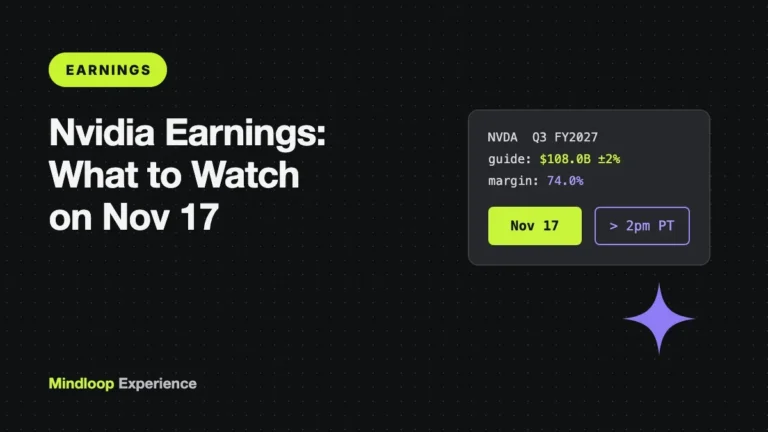
- 17 November. Nvidia reports quarterly results, and our earnings preview lists the questions.
- The Hugging Face deal. TechCrunch says it is expected to close in 2027.
- A permanent CEO. Nvidia has said it will consider internal and external candidates.
This article explains a business story and is not investment advice. Facts are as of 15 November 2026.
Frequently asked questions
Who is Nvidia’s CEO now that Jensen Huang has resigned?
CFO Colette Kress is interim CEO. Nvidia announced on 12 November that Huang had resigned as president, CEO and board member, gave no reason, and said it will consider internal and external candidates for a permanent CEO.
How many startups has Nvidia invested in?
PitchBook, via TechCrunch, says Nvidia joined 105 startup funding rounds in 2026 so far, after 67 venture deals in 2025. Its backed companies include CoreWeave, Crusoe, Mistral AI, Lambda, Black Forest Labs and Reflection AI.
Will Nvidia stop funding AI startups after Huang’s exit?
Nothing is announced. Investors told TechCrunch they expect Kress to be more selective and write smaller checks, but that is a forecast. Nvidia’s quarterly filing still lists $25 billion in further equity investments, subject to certain contingencies.
Is the Nvidia Hugging Face deal still happening?
Per TechCrunch, Nvidia has agreed to buy Hugging Face for $13 billion, the deal is not yet finalized, and it is expected to close in 2027.
Quick quiz
Who is Nvidia’s interim CEO?
- Colette Kress
- Jensen Huang
- Dharmesh Thakker
Nvidia named CFO Colette Kress interim CEO after Huang resigned.
How much has Nvidia agreed to pay for Hugging Face?
- $6 billion
- $800 million
- $13 billion
TechCrunch reports a $13 billion deal that is not yet finalized.
Which figure comes from Nvidia’s own quarterly filing?
- Smaller future checks
- $25 billion in committed investments
- 105 rounds in 2026
The $25 billion commitment is in the filing, while smaller checks are an investor prediction.
Building an AI startup in the Gulf? Dubai runs a program for testing AI products with regulators: Dubai AI Sandbox: who can apply and how to apply before December 18.
Sources
Links last checked on 15 November 2026.
- TechCrunch: Jensen Huang’s departure blasts big hole in AI startup funding, VCs and founders say (13 November 2026)
- TechCrunch: Jensen Huang’s exit puts Nvidia’s support for open source in question (12 November 2026)
- TechCrunch: Nvidia has already committed $40B to equity AI deals this year (9 May 2026)
- SEC: Nvidia quarterly report (10-Q) for the period ended 26 July 2026
- Nvidia: NVIDIA Announces CEO Transition (12 November 2026)


Write a response