The boiler stops on a cold Tuesday. The car fails its MOT. A contract ends a month earlier than promised. None is a disaster on its own, but each becomes a crisis if the only way to pay is a credit card you can’t clear.
Key takeaways
- An emergency fund is cash set aside only for unplanned costs, so a one-off shock doesn’t become long-term debt.
- MoneyHelper’s rule of thumb is three to six months of essential outgoings, but smaller starter targets help too.
- Keep it in a separate, insured, instant-access savings account, not in investments or your everyday current account.
- If you carry expensive debt, build a small buffer first, clear the debt, then return to the full target.
An emergency fund is the unglamorous fix: cash kept aside purely for the unexpected. This guide covers how much to aim for (with smaller first targets if the full amount feels impossible), where to keep it, how to build it on a tight budget, and how it fits alongside paying off debt.
What an emergency fund is for
The US Consumer Financial Protection Bureau (CFPB) defines an emergency fund as a cash reserve specifically set aside for unplanned expenses or financial emergencies, such as car repairs, home repairs, medical bills or a loss of income.
The point is to stop a one-off shock from turning into long-term debt. The CFPB notes that people who struggle to recover from a financial shock often rely on credit cards or loans, and that if you borrow to pay for an emergency, the cost can grow well beyond the original bill because of interest and fees.
How many people have one
In the US, the Federal Reserve’s Economic Well-Being of U.S. Households in 2025 report, published in May 2026 and based on a survey of nearly 13,000 adults in October 2025, found:
- 63% of adults would cover a surprise $400 expense entirely with cash or its equivalent (including a credit card paid off in full at the next statement). That share has barely moved for several years.
- 12% said they could not pay a $400 expense by any means.
- 15% would put it on a credit card and pay it off over time, the most common fallback.
- 55% had set aside enough in a “rainy day” fund to cover three months of expenses, down from a high of 59% in 2021.
- 18% said the largest emergency expense they could handle right now from savings alone was under $100.
The same report found a strong link between habits and resilience. Among adults who always had money left over at the end of the month, 86% had three months of expenses saved. Among those who never did, only 13% had.
By the numbers
63%would cover $400 with cash
12%could not pay $400 at all
55%had three months saved
How much should you save?
The full target: three to six months of essentials
MoneyHelper, the UK government-backed guidance service, says a good rule of thumb is three to six months’ essential outgoings kept in an instant access savings account. Its example: if you spend £1,000 a month on rent or mortgage, food, heating and other things you can’t live without, you might aim for £3,000 to £6,000.
Note the word essential. You are budgeting for a lean month, not a normal one, so leave out takeaways, holidays and subscriptions you could pause. MoneyHelper points out that you need more than repair money: if you lost your job or went through a break-up, you would want enough to give yourself time to recover.
The CFPB says the right amount depends on your situation. As a rough guide, the higher end makes more sense if your income is irregular, you are self-employed, you are the only earner in the household, or you have dependants.
Starter targets that feel reachable
Three months of essentials can look like a mountain, so break it into stages:
- Your typical surprise bill. The CFPB suggests thinking about the most common unexpected expenses you’ve had in the past and what they cost. If the car or boiler usually costs around £400 to fix, that is your first goal. The Fed’s $400 question is a useful benchmark for the same reason.
- One month of essentials. This covers a late pay packet or a short gap between jobs.
- Three months of essentials. The Federal Reserve’s survey calls this one common measure of financial resilience.
- Six months, if your situation calls for it.
Each stage is useful on its own. As MoneyHelper puts it, any amount saved will help if you need to pay for something you weren’t expecting.

Where to keep it
An emergency fund has three jobs: it must be safe, quick to reach, and slightly out of sight so you don’t spend it on non-emergencies. That rules out investments that can fall in value just when you need the cash, and it argues against leaving the money in your everyday current account.
A separate, insured, easy-access savings account
For most people this is the best home. The CFPB describes a bank or credit union as generally considered one of the safest places to put your money and suggests a dedicated account for these funds. It also mentions cash at home or a prepaid card as options, while warning that cash can be lost, stolen or destroyed.
Check that the account is protected by a deposit guarantee scheme:
- US banks: the FDIC insures deposits up to $250,000 per depositor, per FDIC-insured bank, for each account ownership category, and savings and money market deposit accounts are covered.
- US credit unions: the NCUA’s Share Insurance Fund covers accounts at federally insured credit unions up to $250,000 for a single-owner account.
- UK banks, building societies and credit unions: the Financial Services Compensation Scheme (FSCS) protects up to £120,000 per eligible person, per institution. The limit rose from £85,000 on 1 December 2025. Joint accounts are covered up to £120,000 per person.
One UK catch: some brands belong to the same banking group and share a banking license. The FSCS treats those as one bank, so the £120,000 limit applies across all of them combined. You can check on the Financial Conduct Authority’s register. For most emergency funds this limit is far above the balance, but it matters if you hold large savings with one group.
Instant access or notice?
MoneyHelper’s guidance specifically says instant access. Notice accounts make you wait before withdrawing and fixed-term accounts lock the money away, and a 30- or 95-day wait defeats the purpose of an emergency fund. Once you have a solid instant-access buffer, some people keep a second layer in a notice account, but the first layer should be reachable the same day.
Compare accounts by their AER (UK) or APY (US), which our explainer on how compound interest works breaks down. The FDIC’s national average rate on savings accounts was 0.38% as of October 2026, so it pays to compare rates before you pick an account.
Did you know?
Some UK brands share one banking license, so the FSCS treats them as one bank and the £120,000 protection limit applies across all of them combined.
How to build it, step by step
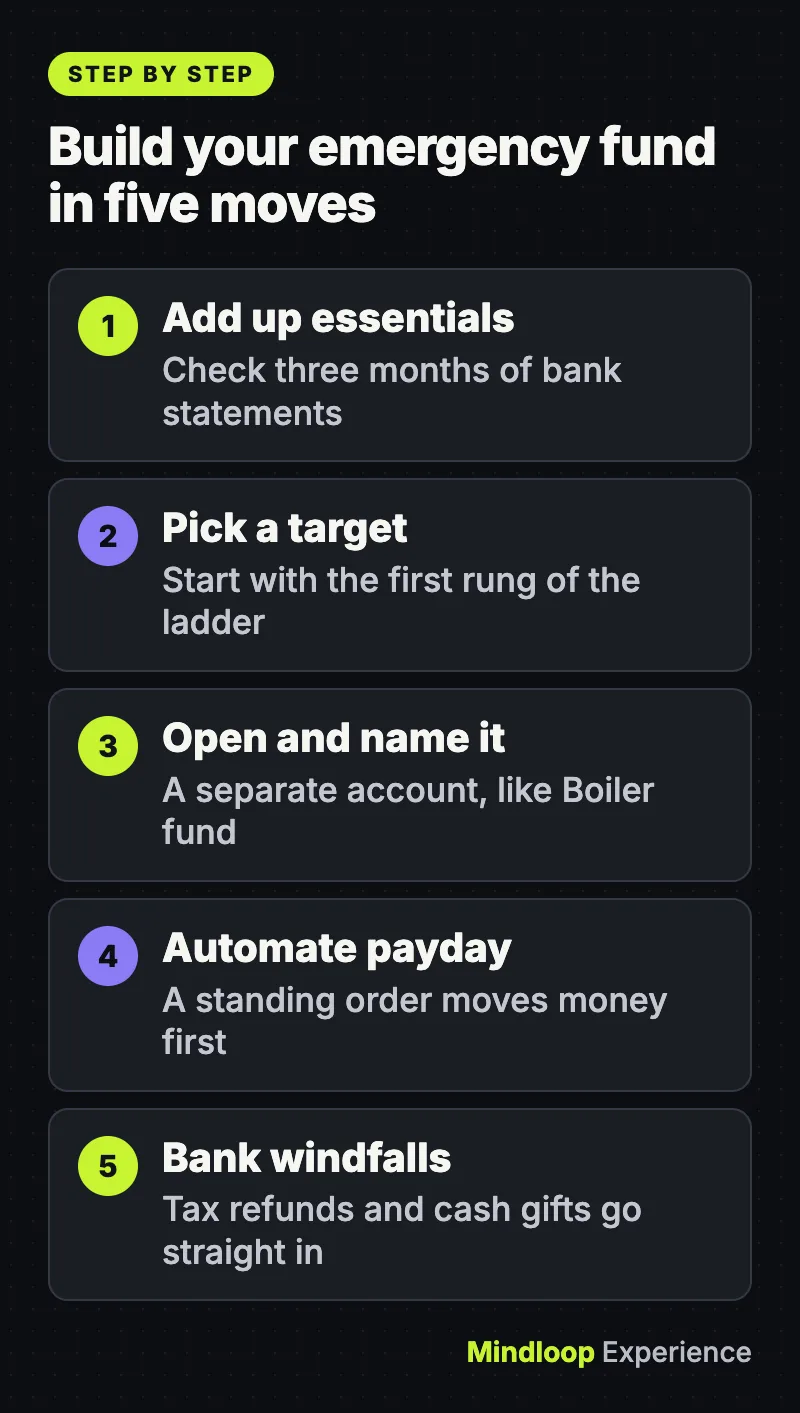
- Work out your essential monthly spend. Add up rent or mortgage, energy, water, council tax or property tax, food, transport, insurance, phone and minimum debt payments. Your bank statements from the last three months will tell you more than your memory.
- Pick your first target. Use the starter ladder above.
- Open a separate account and give it a name. “Boiler fund” or “Emergencies only” is harder to raid than “Savings 2”.
- Automate it. The CFPB calls recurring transfers one of the easiest ways to save consistently. Set a standing order for payday, so the money moves before you can spend it. If your employer allows it, you can split your pay between two accounts.
- Start small and stay regular. MoneyHelper says smaller, regular amounts are often more effective than larger ones now and again, because you build the habit without overcommitting. £25 a week adds up to £1,300 in a year.
- Bank the windfalls. The CFPB suggests putting all or part of a tax refund or a cash gift straight into the fund.
- Use any government top-ups you qualify for. In the UK, Help to Save lets certain people receiving Universal Credit save between £1 and £50 a month and get a bonus of 50p for every £1 saved over four years.
- Track it. The CFPB recommends checking your progress regularly and celebrating milestones.
If money is very tight, the CFPB also suggests looking at your cash flow: some creditors, such as landlords, utility firms and card companies, may let you move due dates so that bills line up better with payday.
When to use it (and when not to)
Decide your rules in advance, while you are calm. The CFPB recommends setting guidelines for what counts as an emergency and sticking to them consistently. A good test is whether the cost is necessary, urgent and unexpected. A broken boiler in winter passes. A sale on a new TV does not. Christmas and car insurance renewals are predictable, so they belong in separate savings pots.
When a real emergency happens, use the fund without guilt. The CFPB’s advice is simple: if you spend it down, work to build it up again.
Emergency fund or paying off debt first?
This is where the math matters. In the US, the average interest rate on credit card accounts that were charged interest was 22.36% in the third quarter of 2026, according to the Federal Reserve. A savings account paying a few percent cannot keep up, so a pound or dollar used to clear that debt usually does far more for you. Our guide to compound interest shows how quickly a high-rate balance snowballs.
MoneyHelper is direct about this. If you have credit card debt, an unauthorized overdraft, payday loans, home credit or mortgage arrears, it says it would be cheaper in the long run to pay these off first. If you are keeping up with your mortgage and any other credit is low-cost, temporary or under control, it suggests adding to your emergency fund.
One practical middle path is to do both: build a small starter buffer so the next surprise doesn’t go on the card, then throw everything else at the expensive debt, then return to the full three-to-six-month target once it is cleared. Without any buffer, every emergency adds to the debt you are trying to clear.
Did you know?
In the US, the average interest rate on credit card accounts charged interest was 22.36% in the third quarter of 2026, far above what a savings account pays.
Frequently asked questions
Generally not. Investments can fall in value, possibly just when you need the money. The CFPB stresses that an emergency fund should be safe and accessible, which is why an insured savings account is the usual home.
Not really. Borrowing can bridge a gap, but the CFPB warns that interest and fees can make an emergency cost far more than the original bill.
Either works if you agree what counts as an emergency. In the UK, the FSCS covers joint accounts up to £120,000 per eligible person, so a joint fund is protected in the same way.
Start anyway. MoneyHelper says saving what you can as regularly as you can makes a big difference, and a regular habit is easier to grow later.
This article explains general principles and is not personal financial advice. If you are struggling with debt, free and confidential help is available from government-backed services such as MoneyHelper in the UK, which can point you to a debt adviser.
Quick quiz
What does MoneyHelper suggest as a rule of thumb for an emergency fund?
- One week of pay
- A year of full spending
- Three to six months of essential outgoings
MoneyHelper says a good rule of thumb is three to six months’ essential outgoings in an instant access account.
Where does the guide say an emergency fund should usually live?
- An insured instant-access savings account
- A stocks and shares fund
- A 95-day notice account
It must be safe and quick to reach, so a separate insured easy-access savings account is the usual home.
How much does the FSCS protect per eligible person, per institution?
- £85,000
- £120,000
- £1,000
The FSCS limit rose from £85,000 to £120,000 on 1 December 2025.
Sources
Links last checked on 15 November 2026.
- An essential guide to building an emergency fund | Consumer Financial Protection Bureau
- Federal Reserve: Economic Well-Being of U.S. Households in 2025
- MoneyHelper: Three to six months’ essential outgoings
- Understanding Deposit Insurance | FDIC.gov
- Share Insurance Coverage | NCUA
- See how FSCS protects banks, building societies and credit unions | FSCS
- National Rates and Rate Caps – October 2026 | FDIC.gov
- Get help with savings if you’re on a low income (Help to Save): How it works – GOV.UK
- Federal Reserve Board – Consumer Credit – G.19




Write a response