Alibaba’s Qwen team released Qwen4-Max on 16 November 2026 and called it “your new AI teammate”. It is a 2.4-trillion-parameter model with a one-million-token context window and native vision, and it costs less than the model it replaces. It reached the Hacker News front page within hours.
Key takeaways
- Alibaba released Qwen4-Max on 16 November 2026: 2.4T parameters, 71B active per token, native vision and a one-million-token context.
- It is not open-weight; you use it through QwenCloud’s API or Token Plan and apps such as QwenStudio.
- The list price is $1.50 per million input tokens and $4.50 per million output tokens, 25% below Qwen3.8-Max.
- Artificial Analysis scores it 43 on its Intelligence Index, above the median of 41 but not at the frontier.
This guide covers what was released, which of the launch numbers come from Alibaba and which come from an independent benchmark, what the model costs, and how to send it your first request. All facts are as of 16 November 2026.
What Alibaba actually released
Qwen4-Max is the first model in the Qwen4 family, and the official launch post describes it as a model for “work, creativity, and discovery”. The focus is long tasks rather than chat. Alibaba’s examples include building 3D scenes in Blender, making playable games in Unity, Unreal Engine and Godot, legal due diligence across 198 working papers, and a 48-hour agent run that designed a new coolant molecule.
Three points matter more than the demos:
- It is not open-weight. Qwen4-Max is available only through Alibaba’s apps and API. Artificial Analysis lists it as a proprietary model. Alibaba says smaller Qwen4 models “are coming to open source”, but gives no date.
- It is available now. The launch post says the model is live on QwenCloud through the Token Plan or the API, and also in QwenWork, Qoder and QwenStudio.
- It ships with an agent feature called Live Delivery. On long tasks the agent hands over a working first version early and keeps improving it, so you can correct it partway through. Alibaba is open-sourcing a Qwen-Live-Delivery-Plugin to go with it.
If you have used earlier Qwen models through tools like Qwen Code, Qwen4-Max is the new top of that range.
Did you know?
In one Alibaba demo, Qwen4 ran for 48 hours on its own and designed a new coolant molecule for data-center chips that a lab then synthesized.
What’s under the hood
According to Alibaba, Qwen4-Max is a sparse mixture-of-experts (MoE) model. Only part of the network runs for each token:
- 2.4 trillion backbone parameters, of which 71 billion are active per token.
- An extra 328 billion “N-gram Embedding” parameters that look up common local token patterns cheaply.
- A new attention design. Gated DeltaNet layers compress older context into fixed-size states, and Qwen Sparse Attention picks out only the relevant blocks of a long input. This is what makes a one-million-token window affordable.
- “Gated Residual” connections, which the team credits with a training run that had “no loss spikes”.
Alibaba also says the base model scores 5-13% better than Qwen3.8-Max-Base on its internal tests while activating 25% fewer parameters. These are in-house measurements that nobody outside Alibaba has checked.

The numbers Alibaba is claiming
The launch post leans on Work360, a benchmark Alibaba built itself. It covers 26 top-level work domains and 721 specialized fields. Here is what Alibaba reports:
| Claim (Alibaba’s own figures) | Qwen3.8-Max | Qwen4-Max |
|---|---|---|
| Work360 score | 47.74 | 52.69 |
| Average cost per Work360 task | $4.43 | $1.67 |
| Secure-code pass rate (function level) | 22.0% | 31.8% |
The cost figure is the headline: a 62% drop per task. Two things produce it. The new model uses fewer tokens for the same job (about 24-35% fewer on Work360 and 48-49% fewer on Terminal-Bench 4.0, depending on effort level), and the price per token is lower.
Treat these numbers carefully. Work360 is Alibaba’s own test, the comparisons are against its own previous model, and the industry case studies, such as cutting workpiece programming from 475 minutes to 24, come from partner deployments that Alibaba picked to show.
What an outside benchmark says
Artificial Analysis runs the same nine evaluations on every model it lists. Its first results for Qwen4-Max give a more modest picture:
- Intelligence Index: 43, ranked 38th of 81 models. The median for comparable models is 41, so Qwen4-Max is above average but not at the frontier.
- Verbose: it produced 127M output tokens across the index, against a median of 78.6M. In practice it writes more for each answer.
- Cost to run the index: $3.27 per task on average.
- It accepts text and image input, outputs text, and has a listed context window of 984k tokens.
For most people that is the useful takeaway. Qwen4-Max is a competent, well-priced model for long agent tasks, but this benchmark does not show it ahead of the best Western models.
Did you know?
Qwen4-Max produced 127M output tokens across the Artificial Analysis index, against a median of 78.6M, so it tends to write long answers.
What it costs
The Model Studio pricing page lists qwen4-max on the international (Singapore) deployment at:
- $1.50 per million input tokens
- $4.50 per million output tokens
- One price for thinking and non-thinking mode, for any request up to 1M tokens
- A free quota of 1 million tokens, valid for 90 days
Qwen3.8-Max sits on the same page at $2 input and $6 output, so the new model costs 25% less on both. Alibaba also says it made “particularly large reductions” to cached-input pricing, and Artificial Analysis lists a 95% cache discount.
For comparison with a Western flagship, see our GPT-6.1 Sol API quickstart, which covers OpenAI’s prices.
By the numbers
$1.50per million input tokens
$4.50per million output tokens
62%lower cost per task (Alibaba)
How to try Qwen4-Max
What you need: an Alibaba Cloud account with Model Studio activated, an API key, your workspace ID, and for the SDK route Python with the openai package installed (pip install openai).
- Try it without code. The launch post points to QwenStudio and Alibaba’s apps. That is the quickest way to judge whether the model suits your work.
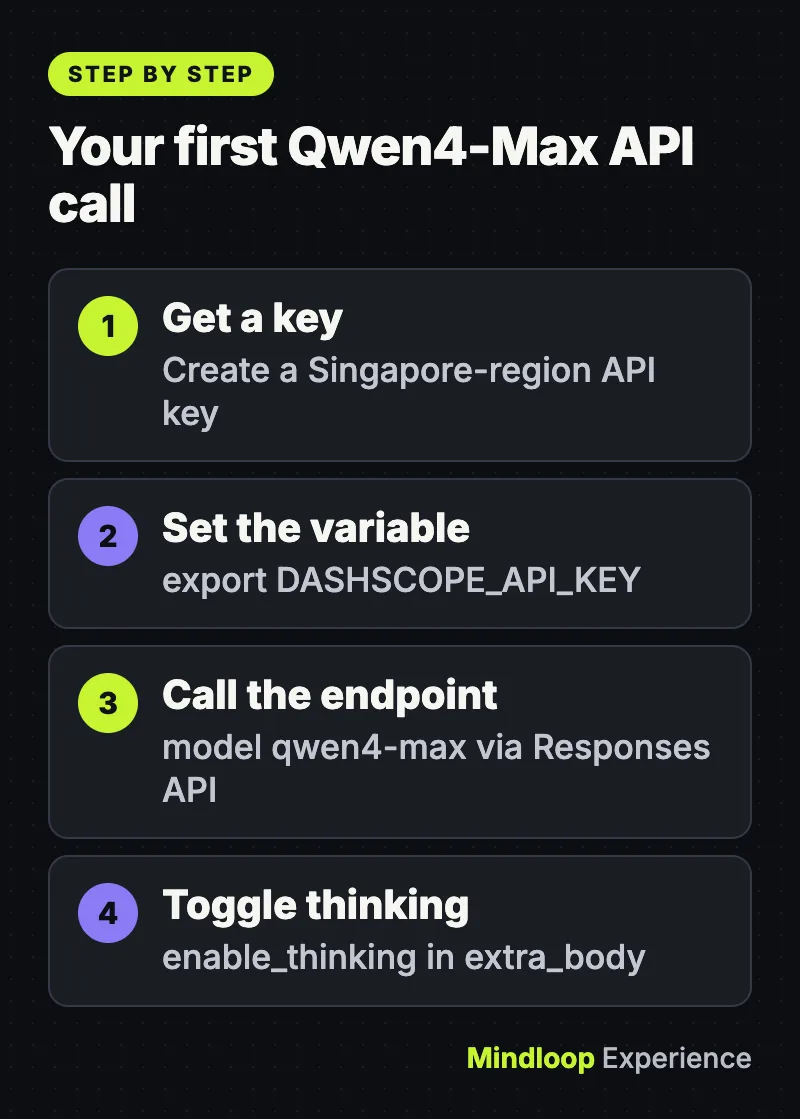
- Get an API key. In the Model Studio console, create an API key for the Singapore region. Alibaba’s docs note that API keys differ by region. Store it as an environment variable rather than in your code:
export DASHSCOPE_API_KEY="sk-your-key-here"- Send a first request with curl. Alibaba’s first API call guide uses an OpenAI-compatible Responses endpoint. Replace
{WorkspaceId}with your own workspace ID:
curl "https://{WorkspaceId}.ap-southeast-1.maas.aliyuncs.com/compatible-mode/v1/responses" \
  -H "Authorization: Bearer $DASHSCOPE_API_KEY" \
  -H "Content-Type: application/json" \
-d '{ "model": "qwen4-max", "input": "Who are you?" }'- Use the OpenAI Python SDK. The endpoint is OpenAI-compatible, so you only change the base URL and the model name:
import os
from openai import OpenAI

client = OpenAI(
    api_key=os.environ["DASHSCOPE_API_KEY"],
    base_url="https://{WorkspaceId}.ap-southeast-1.maas.aliyuncs.com/compatible-mode/v1",
)
response = client.responses.create(model="qwen4-max", input="Who are you?")
print(response.output_text)- Turn thinking on or off. According to the deep thinking docs, Qwen4-Max is a hybrid model: you switch reasoning on per request with
enable_thinking. This is not a standard OpenAI parameter, so it goes inextra_body:
completion = client.chat.completions.create(
    model="qwen4-max",
    messages=[{"role": "user", "content": "Plan a three-step database migration."}],
    extra_body={"enable_thinking": True},
    stream=True,
)
Leave thinking off for quick lookups, and turn it on for planning, math and multi-step code. With thinking on, the model writes more, and you pay for those tokens.
Common errors and fixes
- Authentication errors: the key and the endpoint must belong to the same region. A key from another region will not work on the Singapore endpoint.
- Requests to a URL with
{WorkspaceId}still in it fail: the placeholder must be replaced with your real workspace ID from the console. enable_thinkingraises an error in the SDK: pass it insideextra_body, not as a keyword argument of its own.- Bills higher than you expected: Artificial Analysis found the model verbose. Set a maximum output length and use thinking only where it helps.
What it means for you
- If you build agents: Qwen4-Max is worth a test on long, tool-heavy tasks. The price is below most frontier models, and caching cuts it further. Run it on your own tasks before trusting the 62% claim.
- If you need to run models locally: this one won’t help, because the weights are not public. For now, look at the open models covered in our guide to running Qwen 3.8 locally with llama.cpp, and watch for the smaller Qwen4 models Alibaba has promised.
- If you only chat: you can try it in Alibaba’s apps, but by outside benchmarks the model is above average rather than a clear upgrade over what you already use.
- If your data is sensitive: this is a hosted model run by Alibaba Cloud. Check where your region’s endpoint runs and what your company allows before sending it documents.
More on the models behind these tools is in our AI & Technology section.
Frequently asked questions
Is Qwen4-Max open source?
No. Qwen4-Max is only available through Alibaba’s apps and API. Alibaba says smaller Qwen4 models are coming to open source, without a date.
How much does the Qwen4-Max API cost?
On the international (Singapore) deployment it costs $1.50 per million input tokens and $4.50 per million output tokens, for thinking and non-thinking mode, with a free quota of 1 million tokens valid for 90 days.
Is Qwen4-Max better than Qwen3.8-Max?
On Alibaba’s own Work360 benchmark it scores 52.69 against 47.74, and Alibaba says the average cost per task fell from $4.43 to $1.67. Those are Alibaba’s figures; check them on your own tasks.
Can I use Qwen4-Max with the OpenAI SDK?
Yes. Alibaba’s endpoint is OpenAI-compatible: set the base URL to your workspace’s compatible-mode address, use your DASHSCOPE_API_KEY and set the model to qwen4-max.
Quick quiz
How many parameters does Qwen4-Max activate per token?
- 2.4 trillion
- 71 billion
- 328 billion
It is a sparse mixture-of-experts model: 2.4T backbone parameters, but only 71B run for each token.
Where does the 62% lower cost per task come from?
- Fewer tokens per task plus lower prices
- A free tier
- Open weights
Alibaba says the model uses fewer tokens on Work360 and the price per token dropped.
How do you switch on thinking with the OpenAI SDK?
- Use a different model name
- Pass enable_thinking in extra_body
- Add a system prompt
enable_thinking is not a standard OpenAI parameter, so it goes in extra_body.
Sources
- Qwen4-Max: Your New Teammate Has Arrived (Qwen team)
- Model Studio model pricing (Alibaba Cloud)
- Make your first API call to Qwen (Alibaba Cloud)
- Deep thinking models (Alibaba Cloud)
- Recommended models (Alibaba Cloud Model Studio)
- Qwen4 Max: Intelligence, Performance and Price Analysis (Artificial Analysis)



Write a response