
Carnegie Mellon, whose computer science program U.S. News ranks No. 1, just put real classroom lectures on YouTube for free. On November 16, 2026, its Griffin School of Computer Science launched CS Learn, with eight courses premiering this week, from a beginner programming class to graduate courses on AI agents and machine learning systems. This guide lists every course and its date, helps you pick where to start, and covers what the free version does and doesn’t include, so you can turn a playlist into actual skills.
Key takeaways
- Carnegie Mellon launched CS Learn on November 16, 2026: full classroom lectures from current CS courses, free on the @CMULearn YouTube channel.
- Eight courses premiere in November, from 15-110 Principles of Computing to 11-768 AI Agents, and five more follow in January 2027.
- The free videos have captions and students’ questions as on-screen text, but no homework, credential or stated license yet.
- Pick a course by your level, follow the playlist in order, and build one small project per course to turn lectures into skills.
What Carnegie Mellon launched
CS Learn is a free platform built on lectures CMU was already recording. According to CMU’s announcement, the Software and Societal Systems Department’s videography team had been filming popular courses for years, but the recordings stayed inside CMU. A student group, ScottyLabs, built an AI-assisted system that turns those raw classroom recordings into videos made for online viewers.
The lectures are on a new YouTube channel, CS Learn at Carnegie Mellon (@CMULearn). Phillip Compeau, the teaching professor who runs the project, wrote on Hacker News that CMU is releasing “full semesters of lectures” from current courses, with one course premiering each day this week and more in January. The launch thread was the No. 1 story on Hacker News, with more than 1,900 points by November 17.
Here is the lineup as listed on the CS Learn page on November 17, 2026:
| Course | Title | Teaching | Premiere |
|---|---|---|---|
| 10-605 | Machine Learning with Large Datasets | William Cohen | Out now |
| 15-110 | Principles of Computing | Franceska Xhakaj | Out now |
| 17-214 | Principles of Software Construction | Hammad Ahmad | Tue, Nov 17 |
| 15-442 | Machine Learning Systems | Tianqi Chen and Zhihao Jia | Tue, Nov 17 |
| 17-635 | Software Architectures | Swarnalatha Ashok and Scott Pavetti | Wed, Nov 18 |
| 17-643 | Quality Management | Jeffrey Gennari and Christopher Timperley | Wed, Nov 18 |
| 11-768 | AI Agents | Daniel Fried and Graham Neubig | Thu, Nov 19 |
| 17-645 | Machine Learning in Production | Christian Kästner and Bogdan Vasilescu | Thu, Nov 19 |
| 15-259 | Probability and Computing | Mor Harchol-Balter, Weina Wang and Feras Saad | January 2027 |
| 11-777 | Multimodal Machine Learning | Louis-Philippe Morency | January 2027 |
| 17-619 | Product Management Essentials | Jim Berardone | January 2027 |
| 07-280 | AI and Machine Learning I | Nihar Shah | January 2027 |
| 17-627 | Requirements for Embedded Systems | Scott Pavetti | January 2027 |
The channel already had the first lecture of all eight November courses by November 17, so you can sample each one before its full premiere. The video titles show when each class was taught: some are from Spring 2026 and some are from the current Fall 2026 semester. That matches CMU’s promise that lectures can reach CS Learn “within weeks of the original lecture.”

One mismatch: CMU’s news release also names a “Generative AI” course among the first courses, but it isn’t on the CS Learn page’s list as of November 17.
What you get, and what’s missing
What’s in the free version:
- Full classroom lectures, edited to show the professor and the slides.
- Captions. Compeau said on Hacker News that every lecture has and will have captions.
- Students’ questions as on-screen text. Student faces are blurred and a student’s audio is cut when they ask a question, but the question appears on screen, so you still follow the discussion.
What isn’t there yet:
- Homework, projects and graded work. The CS Learn page says “self-paced courseware” with instant feedback and a badge comes next, and AI tutoring after that. No dates are given.
- A credential. For graded work and an official credential, the page points to CMU Online, which is a separate, paid program.
- A stated license. Hacker News readers asked whether the videos are openly licensed, like MIT OpenCourseWare. As of November 17, CMU hasn’t said. Treat them as normal YouTube videos: watch and share links, but don’t re-upload or redistribute them.
By the numbers
November 16CS Learn launched in 2026
1,900Hacker News points and counting by November 17
January 2027five more courses premiere
How to follow CS Learn (5 minutes)
- Subscribe to @CMULearn and tap the bell, then choose All, so premieres show up in your notifications.
- Open the course playlist, not single videos. Each course on the CS Learn page has a Watch now link that opens its YouTube playlist in order.
- Save the playlist (the Save button under the playlist title), so it’s in You → Playlists on every device.
- Turn on captions with the CC button. Technical terms are easier to catch when you can read them.
- Set the speed. Use Settings → Playback speed. Try 1.25x for review and 1x for new material.
- Join the waitlist for the courseware with the Keep me posted form on the CS Learn page, if you want the exercises when they arrive.

Which course should you start with?
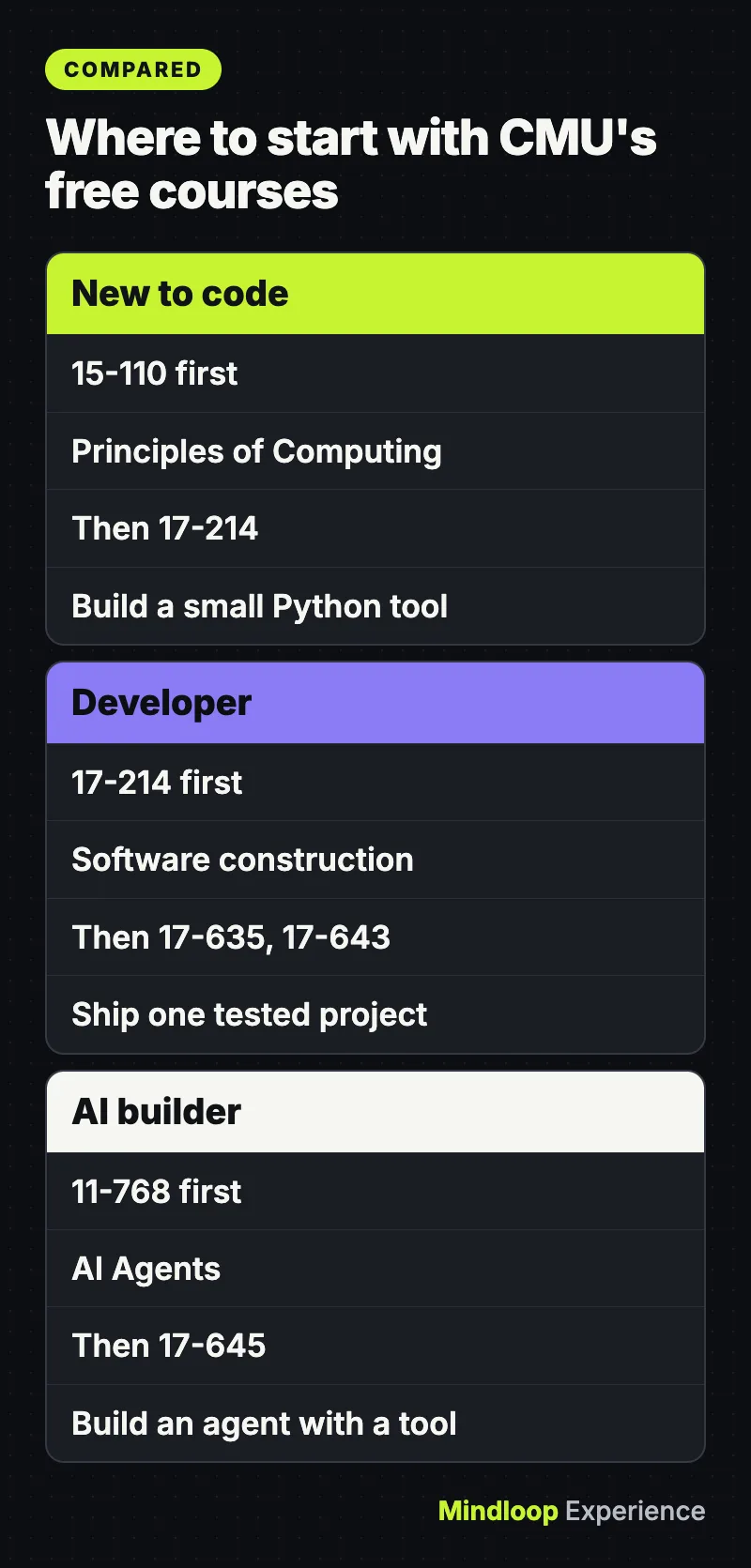
Pick by what you already know, not by which title sounds most impressive. These are our suggestions based on the course titles and CMU’s descriptions, not an official CMU track.
| If you are… | Start with | Then |
|---|---|---|
| New to programming | 15-110 Principles of Computing | 17-214 Principles of Software Construction |
| A working developer | 17-214 Principles of Software Construction | 17-635 Software Architectures, 17-643 Quality Management |
| Building with AI tools or agents | 11-768 AI Agents | 17-645 Machine Learning in Production |
| Into ML engineering or GPUs | 10-605 ML with Large Datasets | 15-442 Machine Learning Systems |
| A product manager | 17-645 Machine Learning in Production | 17-619 Product Management Essentials (January) |
| Into math and theory | 07-280 AI and Machine Learning I (January) | 15-259 Probability and Computing (January) |
If you only have time for one course this month, take 11-768 AI Agents if you already code, or 15-110 if you don’t. If you already use coding agents, pair the AI Agents course with a hands-on project like running several agents in parallel with Git worktrees.
How to actually learn from free lectures
Watching lectures feels like progress, but you only learn by doing the work yourself. Until CMU’s courseware arrives, add the doing yourself:
- Fix a schedule. Two lectures a week, same days, is better than a weekend binge you won’t repeat.
- Pause on every example. Before the professor shows the answer, try it yourself in a notebook or editor.
- Write a one-paragraph summary after each lecture, in your own words. If you can’t, rewatch the part you skipped.
- Build one small project per course. For 15-110, a tiny Python tool; for AI Agents, an agent with one real tool, such as your own MCP server in Python; for ML in Production, a model with a test and a monitoring check.
- Keep your work in Git, so you have something to show. If you’re new to that, start with setting up SSH keys for GitHub.
- Use an AI chatbot as a quiz partner, not as the answer key. Ask it to quiz you on the lecture, then check its answers against the slides.
Did you know?
CS Learn’s videos are made from recordings CMU’s videography team was already shooting for internal use; a student group, ScottyLabs, built an AI-assisted system that blurs student faces and turns their spoken questions into on-screen text.
Common mistakes and fixes
| Mistake | Fix |
|---|---|
| Starting with a graduate course with no background | Start with the course in the “Start with” column for your level and come back later. |
| Watching single videos from search | Use the course playlist so lectures play in order. |
| Missing a course on premiere day | Premieres stay on the channel afterward. Open the playlist any time. |
| Waiting for a certificate | There isn’t one for the free videos. CMU Online is the paid credential route. |
| Re-uploading or clipping lectures for your own channel | No open license is published. Share the link instead. |
What it means for you
For students and career changers in the US and UK, this is a free look at how one of the top computer science programs teaches right now, including subjects few universities teach in public, like AI agents and machine learning systems. It’s also useful to compare against a bootcamp or paid course before you spend money.
For readers in the Gulf, the lectures are on public YouTube, and CMU’s announcement doesn’t mention any country limits. Carnegie Mellon also has a campus in Doha’s Education City. CMU-Qatar offers undergraduate degrees in artificial intelligence, computer science, information systems, business administration and biological sciences, so CS Learn is a free way to sample the teaching style before you apply.
The bigger picture: lectures alone won’t make you job-ready, and CMU says itself that exercises and tutoring are still to come. Use the videos now, build small projects alongside them, and check the CS Learn page in January for the next five courses.
Frequently asked questions
Are Carnegie Mellon’s CS Learn courses really free?
Yes. The lectures are free to watch on the CS Learn at Carnegie Mellon YouTube channel (@CMULearn) and through the CS Learn page. Graded work and an official credential are a separate, paid route through CMU Online.
Do you get a certificate for watching CMU’s free lectures?
No. The free videos don’t come with a certificate. CMU says self-paced courseware with instant feedback and a badge comes next, with no date given, and CMU Online offers graded work and an official credential.
Which CMU course should a beginner start with?
Start with 15-110 Principles of Computing, which is already out, then move on to 17-214 Principles of Software Construction. If you already code and build with AI tools, 11-768 AI Agents is a good first pick.
Can I download or re-upload CMU’s CS Learn videos?
As of November 17, 2026, CMU hasn’t published a license for the videos. Treat them as normal YouTube videos: watch them and share links, but don’t re-upload or redistribute them.
Quick quiz
Where are CMU’s free CS Learn lectures published?
- On a paid CMU portal
- On YouTube, at @CMULearn
- Only on campus
The lectures are free on the CS Learn at Carnegie Mellon YouTube channel, linked from the CS Learn page.
What does the free version include?
- Graded homework
- An official credential
- Captions and students’ questions as text
Lectures have captions and show students’ questions as on-screen text; homework and credentials aren’t part of the free videos.
When do the next five courses premiere?
- December 2026
- January 2027
- Summer 2027
The CS Learn page lists 15-259, 11-777, 17-619, 07-280 and 17-627 as premiering in January 2027.
Sources
- CS Learn, Carnegie Mellon Griffin School of Computer Science
- CMU Opens Access to Top Computer Science Classes Through Free CS Learn Platform (CMU News, November 16, 2026)
- CS Learn at Carnegie Mellon (YouTube channel)
- Hacker News launch thread with comments from Phillip Compeau
- CMU Online
- Carnegie Mellon University in Qatar



Write a response